What Nobody Explained About How You Love

Love Language: Are You Showing Love In A Way That Actually Lands?
If you keep trying harder but it still doesn't land, this might be the missing translation, the one that finally makes your effort readable.
You know that weird moment where you're doing a lot, like actually trying, and somehow it still gets received like you're checked out?
That is usually not a "you suck at love" problem. It's a signal problem.
If you're stuck on questions like "what's my love language" or "how do I show love", you're in the right place. This is the answer that stops the guessing.

What's my love language (the way you SHOW love, not just what you want)?
A lot of quizzes answer "what is your love language" by asking how you want to receive love. Useful, but incomplete.
This one answers the question behind the question: how do I show love when it actually matters? Like when you're stressed, busy, annoyed, or trying not to make a big deal out of it.
Also, this is a Love Language quiz free. No paywall to get the basic answer. You get your result right away.
And it goes deeper than "what are the love languages" basics. It also maps the parts that quietly decide whether your love lands or gets missed, like:
- How you repair after tension (your default way of reconnecting)
- Whether you get stuck performing love instead of expressing it naturally
- How direct you are with words
- Whether you go into fixer mode
- What you do when stress hits and your usual style changes
- Whether you expect love back in the same form you give it
In other words, you get more than "what are the 5 love languages". You get the translation guide.
The 5 ways you usually show love (your primary signal):
Words of Affirmation
You show love through specific words that land. You notice effort and you name it.
Key signs:- You remember exact phrases people said to you for years
- You want clarity, not guessing
- You naturally encourage and build people up
Best part: when you learn to make it concrete, your partner finally feels chosen.
Quality Time
You show love by being fully there, not half-there. Your attention is the gift.
Key signs:- You crave real moments, not constant texting
- You notice when you're together but not connected
- You protect time like it's a limited resource
Best part: when you do it right, love stops feeling like logistics.
Physical Touch
You show love through closeness, warmth, and contact (not just sex).
Key signs:- A hug can reset your whole nervous system
- You reach for your partner without thinking
- Distance feels louder than words
Best part: when you learn consent and timing well, touch becomes trust.
Acts of Service
You show love by doing. Fixing. Handling. Carrying weight so they don't have to.
Key signs:- You notice problems before they become problems
- You prove loyalty through consistency
- You feel loved when effort is recognized
Best part: with one sentence of translation, your actions stop being invisible.
Receiving Gifts
You show love by making it tangible. A thoughtful object that says "I remembered you."
Key signs:- You pay attention to details other people miss
- You like milestones, rituals, small surprises
- You care about meaning, not price
Best part: you can create "wow, you really know me" moments on purpose.
6 ways knowing your love language changes everything (fast)

Understand what are the love languages in real life, not just as labels
You stop treating them like personality types and start using them like signals.Identify why "how do I show love" keeps turning into "why isn't this working?"
You see the mismatch between what you're doing and what they're actually noticing.Figure out "how to show affection" without feeling corny or fake
You get options that fit your style, not someone else's idea of romance.Stop guessing "how to show affection in a relationship" under real-world stress
You learn what you default to when you're tired, busy, or irritated, which is when most damage happens.Get cleaner answers to "how to express your feelings to someone you love"
You learn a few sentences that translate your actions into meaning, without sounding like a Hallmark card.Finally make progress on "how to show my wife I love her" in a way she actually feels
Not more effort. Better targeting.
Hunter's Story: The Pattern I Couldn't Name Until I Did
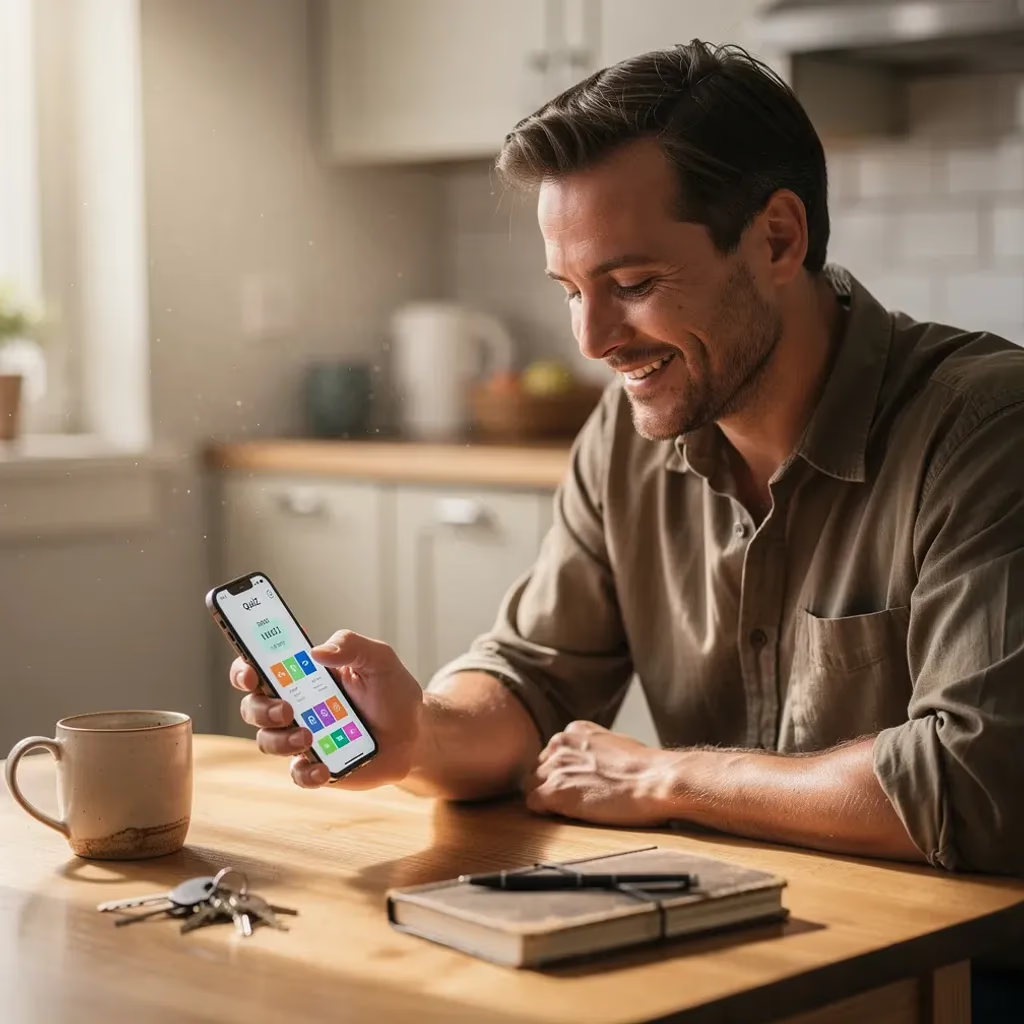
I was in my car in a grocery store parking lot, staring at my phone like it had personally betrayed me. Courtney had texted, "Thanks for tonight. You're seriously the sweetest." And that should have been good. That should have landed.
Instead, I read it three times, then sat there with this annoying heat in my chest, because "sweetest" was always the word that showed up right before the slow fade-out.
I turned 40 this year. On paper, my life looks stable. I work as an office administrator for a mid-sized company, the calm one, the "Hunter will handle it" guy. I can keep a meeting moving, catch a scheduling conflict before it blows up, and make three departments stop fighting long enough to get something done. People think that means I'm calm in general.
The part they don't see is what I do after work: I take the long way home. Windows down, no music, just me replaying conversations like game film. I tell myself it's thinking things through. Sometimes it's just me trying to figure out what I missed.
Love has always been the one area where I can't make my competence transfer over.
With Courtney, I tried to do everything right. I picked the restaurant she mentioned once in passing. I got there early because I hate that feeling of someone waiting on me. I asked questions. I listened. I didn't talk about myself too much. I drove her home when it got late and made sure she got inside.
Then I went home and opened my notes app like an idiot, because I wanted to remember every detail and not screw up whatever this was becoming.
That's the thing I hate admitting: I treat dating like a job interview I can't prepare for. I can be relaxed in the moment, but later I get this itch under my skin. Did I come on too strong? Did I not come on strong enough? Was she laughing because she liked me or because she was being polite? If I text first, I'm too eager. If I don't, I'm distant. I can talk myself into either story.
And the women I've dated, the ones who actually seemed good, they always said some version of the same thing.
"You're a catch."
"You're going to make someone really happy."
"You're such a good guy."
It's like I was always being reviewed for a role that didn't exist.
My default move when I'm interested is to give. I bring coffee. I fix the little problem they mention. I offer to pick something up on my way. I do the thing before they have to ask. I thought that was what love looked like. Show up. Be useful. Make it easier for her to breathe.
But somewhere along the way, "useful" became my whole identity in relationships. If she needed something, I was on it. If she sounded tired, I started problem-solving. If she was stressed, I offered solutions and errands and "I'll handle it."
I was basically a walking customer support line with a decent haircut.
And then I'd get confused when she didn't feel closer to me.
The ugliest part was what happened when I did get close to someone. Not physically, I mean emotionally. When there was actual momentum. When I could sense she mattered to me.
That's when my brain would start scanning for the exit sign.
I'd catch myself checking my phone too much. I'd watch the read receipts. I'd feel my mood dip if her response time changed. I'd tell myself I was just paying attention, just being tuned in. Really, I was trying to control uncertainty.
Then I'd over-correct. I'd act cool. I'd wait too long to text back. I'd pretend I had other plans. I'd manufacture distance because I didn't want to be the one holding the risk.
I'd be both the guy who over-gives and the guy who disappears. Somehow, I managed to do both in the same week.
Sitting in that parking lot, I finally admitted something that had been floating around the edges for a while: I wasn't "bad at relationships." I was fluent in one narrow way of showing love, and I kept assuming everyone else would read it the way I meant it.
My counselor had mentioned love languages a couple sessions earlier. Not in a cheesy way. More like a diagnostic tool. She asked me what I actually do when I care about someone. Not what I feel. What I do.
I said, "I help. I take stuff off their plate. I show up."
She nodded like she had heard that sentence a thousand times.
Then she said, "Take a love language quiz. Not to label you. To get a clean read on your default settings."
I almost rolled my eyes. I'm not anti-therapy, but I am tired of concepts that sound nice and don't change anything. Still, I took her advice because I didn't have a better plan, and because I was sick of feeling like I was always one wrong move away from being dismissed.
That night, after another late drive, I sat at my kitchen table and took the quiz. I expected something vague. What I got was specific enough to sting.
It told me my strongest ways of giving and receiving love were Acts of Service and Words of Affirmation, with Quality Time right behind them. Physical Touch was there too, but not as the main event. Receiving Gifts was last, which made me feel smug for about two seconds until I realized how irrelevant that ranking was to my actual problem.
The quiz explanation used more polished language, but in normal words it was this: I show love by doing. I feel loved when my effort is noticed, named, and appreciated. Not worshipped. Just acknowledged.
That last part hit hard. Because I have always acted like I don't need praise. Like I'm above it. Like I'm solid.
I'm not above it. I just hate needing anything from anyone.
The quiz didn't just tell me my love language. It showed me why my relationships kept going sideways.
If I'm always doing acts of service, and she's wired for Quality Time, my help can register as... background noise. Like I did chores and errands while never actually being with her. If she's wired for Words of Affirmation, but I'm not saying anything because I think my actions should speak, she can feel like I'm not invested. If she's wired for Physical Touch, and I'm being "respectful" by keeping distance, I might be starving her without realizing it.
I kept giving love in the format that made sense to me, then getting resentful when it didn't land. Not openly resentful, more like quiet math in my head. I did this, I did that, I showed up, I fixed it. Why do I still feel like I'm auditioning?
I sat there and laughed once, just under my breath, because it was so obvious in hindsight. I'd been trying to send a message in English to people who were listening in Spanish, then acting like they were the problem when they didn't respond correctly.
Here's where it started to shift: I stopped treating "showing love" like a character trait and started treating it like communication.
Courtney was the first place I tested it, and I tested it badly at first. I tried to force myself into a new style overnight, which is exactly how I ruin things. I overdid it. I went from helpful to weirdly intentional in a way that probably felt like I was reading from a script.
So I backed up. I started doing this thing where I'd pause before I did the automatic helpful move.
Like, she'd mention she was stressed about an exam. Old me would say, "I'll bring you coffee tomorrow, want me to print your notes, I'll drive you there, I can help you study." New me tried something else. I just asked, "Do you want company while you study, or do you want quiet support from a distance?"
It felt awkward coming out of my mouth. Too direct. Too... intentional. But it also felt clean. Like I wasn't guessing.
She looked at me for a second and said, "Honestly? Company. But not like talking the whole time. Just being there."
So I went to her place with my laptop, sat at the table, and did my own work while she studied. No big gestures. No heroic help. Just presence.
About twenty minutes in, she reached over and put her hand on my forearm for a second, like a quick check-in. I didn't flinch. I didn't overthink it. I just let it happen and kept reading my screen.
That tiny moment did more for me than any grand "I handled everything for you" performance I've ever pulled off.
A week later, she texted me, "I like being around you. It's easy."
Easy. That word did land.
The other big change was Words of Affirmation. I always thought compliments were either cheesy or manipulative. I didn't want to be the guy performing romance. I wanted to be real.
What the quiz forced me to confront is that affirmation isn't performance when it's accurate.
So I started being specific instead of dramatic.
Not "You're amazing." More like, "I noticed how you handled your professor today. You didn't shrink. That was impressive."
Or, "I like how you look when you're focused. It's kind of intense in a good way."
The first time I said something like that, I watched her face change. Not in a movie way. Just a small shift. Like she took it in and it mattered.
And then she did something back that I didn't know I needed until I got it. She acknowledged me.
Not in a huge speech. She just said, "Thanks for saying that. And also... thanks for being consistent. It's rare."
My chest did that stupid warm thing again, but this time it wasn't panic. It was information. It was my brain registering, okay, this is contact. This is connection. This is the thing you keep trying to earn by over-functioning.
It didn't make me magically secure overnight. I still had moments where I wanted to check my phone too much. I still caught myself trying to anticipate her moods, like my job was to keep everything smooth. That pattern is ingrained.
But now I had a way to spot it early.
When I felt the urge to "do more" to calm my own uncertainty, I'd ask myself a blunt question: Is this for her, or is this for my anxiety?
Sometimes the answer was humbling.
One night, she took longer than usual to text back. I started building the story immediately. She's losing interest. She's busy with someone else. She's realizing I'm a safe option, not the exciting one. All that familiar garbage.
I wrote and deleted three texts. Then I did the new thing. I waited. I went and took out the trash and cleaned the counter, but not as a love offering. Just because it needed to be done. I left my phone in the other room like it was a dangerous object.
When she finally texted, it was simple: "Sorry, I got pulled into a family thing. Can I call you tomorrow?"
Old me would have said, "Of course, whatever you need," then spent the night feeling like I was being put on a shelf.
Instead I wrote, "Yeah. Tomorrow works. And just so you know, I like hearing from you. Even a quick heads-up helps me not invent stories."
I stared at that message for a full minute before sending it. It was risky. It wasn't a demand, but it was a truth. It was me putting my actual needs on the table without dressing them up as helpfulness.
She replied, "That's fair. I can do that."
No drama. No punishment. No lecture about me being too much.
Just... data exchanged. Agreement made.
That was the moment I understood something I wish I'd learned ten years ago: part of my problem wasn't that I cared too much. It was that I was trying to communicate care indirectly, like I could sneak it past vulnerability by disguising it as competence.
Acts of Service is still in me. It's not going away. If anything, I respect it more now. It's a real strength. I'm reliable. I follow through. I'm the guy who remembers the thing you forgot you said.
The difference is I don't treat acts of service like a substitute for everything else anymore.
If I want connection, I have to include Quality Time. If I want someone to know I care, I have to say it in a way they can actually receive, not just in the way that makes me feel safe.
I'm still learning the balance. I still have nights where I take the long drive because my apartment is too quiet and my thoughts are too loud. I still catch myself wanting to earn love instead of building it.
But now, when things start to get messy in my head, I can usually trace it back to a simple question: Am I speaking the same love language as the person in front of me, or am I just talking to myself and hoping it counts?
- Hunter S.,
All About Each Love Language type
Before you scroll into the deep dives, a quick translation table. This helps if you're still asking "what are the 5 love languages" or "what are the love languages" and you want the plain-English version first.
| Love Language | Common ways it shows up |
|---|---|
| Words of Affirmation | "Tell me you noticed", praise that is specific, reassurance that is direct, encouragement as bonding |
| Quality Time | "Be here with me", protected time, shared activities, phone-down attention, real conversation |
| Physical Touch | hugs, hand-holding, cuddling, sitting close, touch as reassurance, warmth as connection |
| Acts of Service | fixing, planning, errands, problem-solving, reliability, load-sharing, showing up through action |
| Receiving Gifts | small surprises, meaningful objects, remembering details, rituals and milestones, symbols and keepsakes |
Is my love language Words of Affirmation?

If you've ever caught yourself thinking "what is your love language" and the honest answer is "I need the words to match the reality", this might be you.
Words of Affirmation is not being needy. It's being precision-oriented. You want signals you can trust, not vague vibes.
And yes, this connects directly to questions like "how to express your feelings to someone you love" because for you, language is how commitment becomes real.
Words of Affirmation Meaning
Core understanding
This pattern functions as love made legible through language. Your core dynamic is that closeness gets built when effort is named, loyalty is stated, and appreciation is spoken out loud. You don't want constant compliments. You want accuracy.
This often develops when you learned early that guessing costs you. Maybe praise was rare, maybe feedback was mostly correction, or maybe silence usually meant "something's wrong." So you became the guy who listens hard for tone, subtext, and the one sentence that tells you where you stand.
Your brain learned to prioritize verbal certainty. That shows up as a specific response pattern where kind words calm you fast, and cold words (or no words) make your mind start running scenarios at 2am.
What Words of Affirmation Looks Like
"One good sentence can change your whole day": Internally, your body settles when you hear direct appreciation. Externally, you become more present and generous. Example: you get a simple "I noticed what you did today" and suddenly you stop second-guessing everything.
"Silence reads like distance": Your mind fills gaps with meaning. Others think you're overthinking, but you're actually tracking signal clarity. Example: a partner replies with "k" and you feel your chest tighten because you cannot tell if you're good or in trouble.
"You give what you want to get": You naturally encourage people and name what they're doing well. People feel supported around you. Example: you hype a friend before an interview because you know words change performance.
"Harsh tone hits harder than harsh content": It's not only what was said, it's how it landed. You can handle directness if it stays respectful. Example: "We need to talk" in a flat tone makes your stomach drop.
"You remember exact phrases for years": Compliments and insults stick because language is your main channel. Others forget, you replay. Example: you can quote the one time someone said you were "reliable" and it still matters.
"You want conflict to include repair language": After tension, you need a clear reconnect statement. Not begging, just confirmation. Example: "We're good, I love you, I'm just tired" shuts down the thought loops.
"You can smell fake praise": Generic compliments annoy you. Specific recognition works. Example: "You're great" feels empty, but "I appreciated how you handled that call" lands.
"You often ask 'what are the love languages' because yours got dismissed": You've been told words are cheap. For you, words are commitment cues. Example: you don't want poetry, you want clarity.
"You dislike mind-reading games": You'd rather have a direct sentence than a vague hint. Externally, you can look intense. Example: you'd rather hear "I need reassurance" than deal with passive coldness.
"You over-correct after mistakes": When you think you messed up, you try to talk your way back into safety. Example: sending a long text explaining yourself because you can't tolerate being misunderstood.
"You respect verbal leadership": You trust people who can name reality cleanly. In relationships, you look for partners who can speak plainly. Example: a partner who says "I want you" feels safer than one who implies it.
"You can feel lonely in a relationship that's 'fine'": If there's no appreciation expressed, you can feel unseen even with shared life. Example: living together, doing everything right, and still feeling like you're not sure you matter.
"You try to earn words with performance": If you're anxious, you might chase praise through doing more. Example: stacking tasks hoping it triggers a "thank you" instead of just asking.
How Words of Affirmation Operates Across Different Domains
In relationships: You bond through honest appreciation and direct reassurance. "How do I show love" for you often looks like encouragement, naming what you value, and making commitment explicit. You do best with someone who can meet you halfway with clear words, not someone who thinks silence is normal.
In professional settings: You thrive in environments with clean feedback. You may become the unofficial morale builder. When feedback is vague, your brain tries to fill in the blanks and it costs you focus.
In friendships: You're the guy who sends the message people save. You might struggle when friendships stay on banter only. You value loyalty, and you like it said out loud once in a while.
Under pressure: You either get very direct or you over-explain. Your stress move is trying to restore clarity, fast. That is why learning "how to express your feelings to someone you love" in short, clean lines is a superpower for you.
Situations That Activate This Pattern
- When a partner's tone changes and you cannot tell why.
- When texts get short and ambiguous.
- When you're doing a lot and nobody acknowledges it.
- When you feel replaced, compared, or taken for granted.
- When conflict ends with "whatever" instead of a clear repair moment.
- When you have to guess what someone really meant.
What to Do With This
- Translate your need into a clean request: "Words matter to me. Can you say out loud when we're good?" That is direct, not needy.
- Use the one-sentence rule under stress: When you're heated, say one clear sentence, then pause. It prevents the long text spiral.
- Pair your words with one observable action: It keeps your affirmation from sounding like fluff. "I appreciate you, so I'm handling dinner tonight."
- Outcome: Men who understand this pattern stop chasing reassurance through performance. They get clearer, calmer, and their relationships get easier to steer.
Words of Affirmation Celebrities
- Zendaya (Actress)
- Michael B. Jordan (Actor)
- Emma Stone (Actress)
- Ryan Gosling (Actor)
- Anne Hathaway (Actress)
- John Krasinski (Actor)
- Jennifer Garner (Actress)
- Steve Carell (Actor)
- Reese Witherspoon (Actress)
- Hugh Jackman (Actor)
- Tom Hanks (Actor)
- Will Smith (Actor)
- Drew Barrymore (Actress)
- Robert De Niro (Actor)
Words of Affirmation Compatibility
| Other Love Language | Match | Why it tends to work (or not) |
|---|---|---|
| Quality Time | 😍 Dream team | Time plus words makes connection obvious and steady, not guessy. |
| Physical Touch | 🙂 Works well | Touch provides reassurance, words provide clarity, together they cover a lot. |
| Acts of Service | 😐 Mixed | Service can feel like love, but without words it can register as distance. |
| Receiving Gifts | 🙂 Works well | Gifts can become "proof" plus words explain the meaning behind the gesture. |
Is my love language Quality Time?

If you've ever thought "how to show affection in a relationship" and immediately pictured time together, not gifts, not words, not grand gestures, that's a Quality Time signal.
Quality Time people are not asking for 24/7 access. You're asking for undivided presence. The kind where your shoulders drop because you can feel you're not competing with a screen.
This is also why you keep searching "what are the love languages" or "what are the 5 love languages". You're trying to name why being together can still feel lonely.
Quality Time Meaning
Core understanding
This pattern functions as attention equals devotion. Your core dynamic is that love becomes real when time is protected and the moment is shared. Not in a performative way. In a "we're actually here" way.
This often develops when you had to compete for attention early, or you learned that people say they care but disappear when it counts. So your brain started using time as proof. Not money. Not words. Time.
Neurologically, your brain learned to prioritize availability and engagement. That shows up as a response pattern where distracted time makes you feel unsafe, and focused time makes you feel solid. You can literally feel it in your body when someone is half-present.
What Quality Time Looks Like
"You can feel when they're not really there": Internally, your focus sharpens when attention splits. Externally, you get quieter or irritated. Example: you're on a date and they keep checking notifications, and you start thinking "why am I even here?"
"Shared moments beat expensive plans": You prefer simple connection over flashy gestures. Others may think you're low-maintenance, but you're actually high-standards about presence. Example: a walk and a real conversation means more than a fancy dinner with dead silence.
"You ask 'what's my love language' because time is your currency": When you care, you schedule it. You show up. Example: you rearrange your week to make space, and you notice when they don't.
"You hate 'parallel play' when it's constant": Sitting on the couch together scrolling can feel like nothing. Example: you're next to each other, but your chest feels hollow because there's no connection.
"You remember weekends more than gifts": Your memory stores time-based moments as proof of love. Example: that one road trip still carries the whole relationship for you.
"You prefer clean plans": Unclear scheduling makes you anxious. Externally, you look controlling. Internally, you want to know you're a priority. Example: "we'll see" feels like being benched.
"You bond through conversation or shared experience": Not interrogations. Not therapy talk. Just real exchange. Example: cooking together while talking about the week feels like intimacy.
"You can be fine with less texting": If you trust the time you get, you don't need constant pings. Example: one strong date can carry you through a busy week.
"You get hurt by chronic lateness": It reads as disrespect, not a small mistake. Example: they show up 30 minutes late and it feels like a statement.
"You naturally 'date' your partner": You initiate plans because you understand bonding takes time. Example: you book tickets or plan a day trip because it keeps the relationship alive.
"You can misread stress as disinterest": When they are busy, you feel the distance. Example: a partner under pressure goes quiet and you start thinking you're not wanted.
"Your best relationships feel like a team": Time together isn't just romance, it's coordination and shared life. Example: you like running errands together if it feels connected.
How Quality Time Operates Across Different Domains
In relationships: "How do I show love" often becomes "I make time for you." You thrive with partners who can put the phone down and be present. Conflict often starts when time becomes transactional or constantly interrupted.
In professional settings: You build loyalty through being available and present with your people. You're the coworker who actually listens. You may struggle in chaotic environments where everything is fragmented.
In friendships: You prefer a smaller circle with real time. Superficial hangouts drain you. You want "let's actually talk" energy.
Under pressure: You either over-pursue time to feel stable or you shut down because it feels pointless. Knowing your repair style matters here, because the fastest reconnection for you is protected time plus clear attention.
Situations That Activate This Pattern
- When you're together and your partner is distracted.
- When plans are vague, inconsistent, or always changing.
- When you keep hearing "I'm busy" with no replacement plan.
- When conflict prevents time together and nobody initiates repair.
- When work or screens constantly cut into connection.
- When you feel like a background character in their life.
What to Do With This
- Make "quality time" measurable: "Can we do 45 minutes phone-down after dinner twice this week?" That is clean and doable.
- Use a start ritual: A hug, eye contact, one question. It flips the switch into connection fast.
- Ask for a replacement plan, not an apology: "If tonight doesn't work, when does?" This protects you from endless disappointment.
- Outcome: Men who understand this stop begging for attention. They start asking for clean agreements. The relationship gets calmer because expectations are visible.
Quality Time Celebrities
- LeBron James (Athlete)
- Chris Evans (Actor)
- Matthew McConaughey (Actor)
- Blake Lively (Actress)
- Natalie Portman (Actress)
- Mila Kunis (Actress)
- Robert Pattinson (Actor)
- Jennifer Aniston (Actress)
- Chris Pratt (Actor)
- Julia Roberts (Actress)
- George Clooney (Actor)
- Morgan Freeman (Actor)
- Meryl Streep (Actress)
- Daniel Craig (Actor)
- Sandra Oh (Actress)
Quality Time Compatibility
| Other Love Language | Match | Why it tends to work (or not) |
|---|---|---|
| Words of Affirmation | 😍 Dream team | Presence plus clear words makes love obvious and stable. |
| Physical Touch | 🙂 Works well | Time together gives touch a safe context instead of feeling like a shortcut. |
| Acts of Service | 😐 Mixed | Service helps, but if time is missing you can still feel alone. |
| Receiving Gifts | 🙂 Works well | Gifts can become time markers and rituals when paired with presence. |
Is my love language Physical Touch?

Physical Touch gets misunderstood fast. People hear it and assume it's only sex.
If Physical Touch is your love language, you're usually asking something much simpler: closeness that calms your body. Hand on your back. A hug that lasts two seconds longer. Sitting close while you talk.
If you're Googling "how to show affection" or "how to show affection in a relationship" and your mind goes straight to touch, you're not shallow. You're tuned to the physical channel.
Physical Touch Meaning
Core understanding
This pattern functions as connection through contact. Your core dynamic is that touch communicates safety faster than conversation. It's not that words don't matter. It's that touch hits your nervous system like a direct line.
This often develops when you learned that words can lie, but bodies usually tell the truth. Or you grew up in a home where affection was inconsistent, so touch became the clearest signal of "we're good."
Your brain learned to prioritize proximity and warmth. That shows up as a response pattern where distance feels like rejection, even if nobody said anything. Your chest tightens. Your shoulders creep up. One hug can reset it.
What Physical Touch Looks Like
"Touch is your fastest repair tool": Internally, your body settles with contact. Externally, you reach out first. Example: after a tense moment, you offer a hug because it says "I'm still here."
"You can feel the temperature of the relationship": Not metaphorically. Physically. Example: if you haven't been touched in days, you feel restless and disconnected.
"You want everyday affection, not grand gestures": A quick hand squeeze matters more than a big speech. Example: holding hands in the car feels like intimacy.
"You hate being punished with distance": Withdrawing touch can feel like a threat. Example: sleeping back-to-back after an argument makes you feel like the relationship is in danger.
"You can misread stress as rejection": If your partner is overwhelmed and less affectionate, you feel it as a verdict. Example: they say "I'm tired" but your brain hears "I don't want you."
"You show love by initiating closeness": You sit closer, you touch shoulders, you greet with a hug. Example: you instinctively put a hand on their knee during a hard conversation.
"You crave non-sexual touch too": This is the part people miss. Example: cuddling while watching a show matters as much as sex.
"You prefer in-person over texting": Text lacks the physical channel. Example: a phone call is better, but in-person is best.
"You feel safest with clear consent and mutuality": When you mature in this love language, you stop pushing for touch as reassurance and start inviting it. Example: "Can I hold you?" becomes your power move.
"You can become needy when insecure": Not as a character flaw, as a signal that you need clearer reassurance. Example: reaching for sex when you actually need closeness.
"You often ask 'what are the love languages' because yours gets judged": People call it shallow. You know it's bonding. Example: you feel guilty for wanting touch and that guilt creates distance.
"You regulate stress through contact": Touch lowers your internal alarm. Example: you handle hard weeks better when affection stays consistent.
How Physical Touch Operates Across Different Domains
In relationships: "How do I show love" often means initiating affection and keeping the physical channel warm. You do best with partners who enjoy touch and can also set boundaries clearly. The danger zone is using touch to avoid hard conversations. The upgrade is using touch to support them.
In professional settings: You may not express touch at work, obviously, but you read physical signals fast: posture, tension, distance. You're good at knowing when something is off in a room.
In friendships: You may be starved for normal affection because male friendships often lack it. You might not admit it, but it matters. Handshakes, hugs, being physically near your people helps.
Under pressure: You either pursue touch for reassurance or shut down if you feel rejected. This is why learning your conflict repair style matters. It tells you when to ask for a hug and when to give space.
Situations That Activate This Pattern
- When affection drops suddenly.
- When conflict leads to physical distance (sleeping apart, no hugs).
- When your partner avoids contact without explaining.
- When you're stressed and touch is the only thing that calms you.
- When you feel replaced by screens, work, or exhaustion.
- When you want closeness but fear being seen as "too much."
What to Do With This
- Ask for small, consistent touch: "Can we hug when we get home, even if it's a rough day?" Consistency beats intensity.
- Separate touch from persuasion: Touch lands best when it is not used to pressure. Invite, don't grab.
- Build a non-sexual affection menu: Hand-holding, back rub, cuddle, shoulder squeeze. It answers "how to show affection" cleanly.
- Outcome: Men who understand this stop chasing reassurance through sex or panic. They build steady closeness that makes the relationship feel safer.
Physical Touch Celebrities
- Chris Hemsworth (Actor)
- Serena Williams (Athlete)
- Jason Momoa (Actor)
- Scarlett Johansson (Actress)
- Idris Elba (Actor)
- Margot Robbie (Actress)
- Halle Berry (Actress)
- Ryan Reynolds (Actor)
- David Harbour (Actor)
- Penelope Cruz (Actress)
- Denzel Washington (Actor)
- Sylvester Stallone (Actor)
- Goldie Hawn (Actress)
- Patrick Swayze (Actor)
- Al Pacino (Actor)
Physical Touch Compatibility
| Other Love Language | Match | Why it tends to work (or not) |
|---|---|---|
| Quality Time | 😍 Dream team | Presence gives touch safety and meaning, so it doesn't feel like grabbing. |
| Words of Affirmation | 🙂 Works well | Words reduce insecurity, touch seals the bond. |
| Acts of Service | 😐 Mixed | Service helps, but if affection is low you can still feel rejected. |
| Receiving Gifts | 🙂 Works well | Gifts can be rituals that lead into closeness, if touch is welcomed. |
Is my love language Acts of Service?

If you've ever asked "how do I show love" and your first instinct is "I handle it", welcome. Acts of Service is the love language of the reliable guy.
You might not say a lot. You might not post cute captions. You show up. You fix. You plan. You carry weight.
If you're searching "how to show my wife I love her", Acts of Service is usually the most practical answer. The problem is that service can become invisible if nobody translates it.
Acts of Service Meaning
Core understanding
This pattern functions as love proven through reliability. Your core dynamic is "I care, so I reduce your load." You don't just feel devotion, you demonstrate it.
This often develops when you learned early that being useful keeps you safe and valued. Maybe you had to be the capable one. Maybe you were praised for doing, not for being. So you became the guy who earns closeness by making life run smoother.
Neurologically, your brain learned to prioritize problem-solving and threat reduction. Under stress, you go into action mode. That is why you keep asking "how do I show love" and defaulting to doing. It's your most automatic expression.
What Acts of Service Looks Like
"You love by handling the annoying stuff": Internally, service feels like care. Externally, you take tasks off their plate. Example: you notice the car needs gas and you fill it without being asked.
"You fix first, talk later": Your instinct is to solve. Example: your partner vents and you're already listing solutions, thinking you're helping.
"You feel respected when your effort is noticed": Not worshipped, noticed. Example: a simple "thank you for doing that" makes you feel chosen.
"You can start keeping score when tired": It happens when your effort disappears into silence. Example: you do everything, then hear "you never do anything for me" and your jaw clenches.
"Acts become your apology": You repair by doing something helpful instead of saying sorry. Example: after tension, you clean the kitchen and hope it signals reconnection.
"You can unintentionally avoid emotion": Service can become a shield. Example: you keep busy so you don't have to talk about the thing that hurt.
"Your love looks like consistency": You show up the same way, again and again. Example: you're the one who always picks them up when their day blows up.
"You struggle with 'how to express your feelings to someone you love'": Not because you don't have feelings. Because action has always been your language. Example: you feel awkward saying "I need you" but you will drive across town at midnight.
"You get annoyed by performative romance": You prefer real utility. Example: flowers are fine, but fixing the thing that's stressing them out feels like love.
"You are protective": You prevent problems. Example: you plan ahead for travel, handle details, and make sure nobody gets stuck.
"You can feel used if the relationship becomes one-way": Service without reciprocity becomes resentment. Example: you start thinking, "Do they even like me, or do they like what I do?"
"You often attract partners who love being taken care of": Sometimes that's healthy. Sometimes it's a trap. Example: you become the default caretaker and lose your edge.
How Acts of Service Operates Across Different Domains
In relationships: "How to show my wife I love her" becomes "I make her life easier." That works beautifully when it's recognized and balanced. It fails when your partner needs Words of Affirmation or Quality Time and you only give service. Then your care gets misread as distance.
In professional settings: You're the dependable closer. You clean up messes. People trust you. The cost is over-functioning and burnout if you never ask for support.
In friendships: You might be the friend who helps move apartments, fixes laptops, shows up. Sometimes you forget to ask for what you need because you've trained yourself to be the strong one.
Under pressure: You go into urgent fixing mode. Your partner might feel managed instead of loved. Learning to pause and ask one question first can change everything.
Situations That Activate This Pattern
- When your partner is overwhelmed and you see a clear problem to solve.
- When you feel unappreciated for effort.
- When conflict happens and you want to make it right without talking.
- When you're asked for more emotional expression on the spot.
- When you feel responsible for the relationship's stability.
- When you suspect love is conditional on usefulness.
What to Do With This
- Add one translation sentence: "When I do this, it's me saying I love you." That single line makes Acts of Service visible.
- Replace fixing with one question first: "Do you want help or do you want me to listen?" It saves you from solving the wrong problem.
- Set a limit before resentment builds: "I can do X today, not Y." Clear limits keep service from becoming self-erasure.
- Outcome: Men who master Acts of Service stop overgiving for approval. They become steady, respected, and their love lands without exhausting them.
Acts of Service Celebrities
- Keanu Reeves (Actor)
- Tom Brady (Athlete)
- Peyton Manning (Athlete)
- Matt Damon (Actor)
- Harrison Ford (Actor)
- Daniel Radcliffe (Actor)
- Bryan Cranston (Actor)
- J-K Simmons (Actor)
- Jamie Foxx (Actor)
- Sandra Bullock (Actress)
- Julia Louis-Dreyfus (Actress)
- Bob Ross (Artist)
- Steve Irwin (TV Personality)
- Drew Brees (Athlete)
- Jason Sudeikis (Actor)
Acts of Service Compatibility
| Other Love Language | Match | Why it tends to work (or not) |
|---|---|---|
| Receiving Gifts | 🙂 Works well | Gifts can show thoughtfulness; service shows reliability, both feel intentional. |
| Quality Time | 😐 Mixed | You can do a lot, but if time isn't protected they may still feel alone. |
| Words of Affirmation | 😐 Mixed | Your actions need verbal translation or they can get missed. |
| Physical Touch | 🙂 Works well | Touch can soften the "fixer" edge and make your care feel warmer. |
Is my love language Receiving Gifts?

Receiving Gifts is the most unfairly judged love language. People hear it and think "high maintenance."
In reality, it often means: symbols matter to you. Not because you're materialistic, but because you attach meaning to tangible proof of thought.
If you're asking "what are the love languages" and this one feels uncomfortable to admit, you're not alone. The mature version of Receiving Gifts is incredibly grounded.
Receiving Gifts Meaning
Core understanding
This pattern functions as love anchored in symbols. Your core dynamic is "you remembered me when I wasn't in front of you." It's the proof that someone held you in mind.
This often develops when words felt cheap or inconsistent, or when time felt unpredictable. Objects become memory anchors. They keep love from feeling imaginary.
Neurologically, your brain learned to prioritize meaning markers. A small, thoughtful gift can calm you because it answers the question "do I matter to you?" without a big speech.
What Receiving Gifts Looks Like
"You notice effort in the details": Internally, thoughtfulness hits you hard. Externally, you remember what people like. Example: you buy the snack they mentioned once three months ago.
"Cheap but thoughtful beats expensive but generic": Meaning is the currency. Example: a keychain from a trip you talked about matters more than an expensive random item.
"You love rituals and milestones": Birthdays, anniversaries, small wins. Example: you like marking moments because it makes the relationship feel real.
"You feel hurt by forgotten moments": It's not about the date, it's what it implies. Example: they forget your big meeting and you feel a pit in your stomach.
"You can misread 'no gift' as 'no effort'": Especially if other channels are weak too. Example: no time, no words, no touch, and no gift becomes a painful pattern.
"You plan ahead": Receiving Gifts often comes with forethought. Example: you keep notes in your phone of things they mention.
"You show love by curating experiences": Gifts might be tickets, small objects, or setup moments. Example: leaving something on their desk with a note.
"You ask 'what are the 5 love languages' because yours gets called shallow": You know it's not about money. Example: you feel judged for wanting tangible proof.
"You want proof without begging": Gifts can communicate without awkward talks. Example: a simple card says what you can't say easily.
"You bond through shared symbols": Inside jokes, objects, photos. Example: you keep mementos because they store meaning.
"You can overcompensate with gifts when insecure": If you're anxious, you might buy instead of speak. Example: you do a big gesture because you don't know how to say the thing.
How Receiving Gifts Operates Across Different Domains
In relationships: "How do I show love" can look like remembering what matters to them and making it tangible. This pairs well with Words of Affirmation because a note makes a gift land. It pairs well with Quality Time when gifts become rituals that create shared moments.
In professional settings: You understand recognition. You know small tokens matter. You're often good at client relationships and remembering details.
In friendships: You're the friend who brings the thing. The snack, the souvenir, the thoughtful gesture. It's your way of saying "you're in my circle."
Under pressure: You might buy your way out of a conflict. The upgrade is using gifts as a supplement, not a substitute, and adding one direct sentence.
Situations That Activate This Pattern
- When special dates are forgotten.
- When you feel like an afterthought.
- When gifts become transactional or weaponized.
- When you give thoughtful things and receive generic effort back.
- When someone calls you materialistic and you feel misread.
- When you want to reconnect but don't know how to start.
What to Do With This
- Make the meaning explicit: Add one sentence. "I got this because it reminded me of you." That turns the gesture into connection.
- Set a standard without shame: "Small gestures matter to me. Not expensive. Just thoughtful." That is clean.
- Use gifts as anchors for time: Pair a gift with a moment together. It answers "how to show affection in a relationship" in a way that sticks.
- Outcome: Men who own this love language stop apologizing for it. They use it with precision and create loyalty fast.
Receiving Gifts Celebrities
- Rihanna (Artist)
- Taylor Swift (Artist)
- Ariana Grande (Artist)
- Lady Gaga (Artist)
- Pharrell Williams (Artist)
- Drake (Artist)
- Jennifer Lopez (Artist)
- Paris Hilton (Entrepreneur)
- Martha Stewart (Entrepreneur)
- Gordon Ramsay (Chef)
- David Beckham (Athlete)
- Victoria Beckham (Designer)
- Michael Jordan (Athlete)
- Kim Kardashian (Entrepreneur)
Receiving Gifts Compatibility
| Other Love Language | Match | Why it tends to work (or not) |
|---|---|---|
| Words of Affirmation | 😍 Dream team | A note plus a gift makes meaning undeniable and memorable. |
| Quality Time | 🙂 Works well | Gifts become rituals that protect time and mark shared moments. |
| Acts of Service | 🙂 Works well | Service feels loyal, gifts feel thoughtful, together it reads as intentional love. |
| Physical Touch | 😐 Mixed | Touch can be strong, but you may still need symbolic proof and remembrance. |
If you're still stuck, this is the simplest reframe: when you ask "what are the love languages" or "what are the 5 love languages", you're really asking why your effort isn't landing. This quiz gives you the translation so you stop guessing.
The real problem (and the fix) in 4 sentences
When you don't know your love language, you keep trying to answer "how do I show love" with more effort instead of clearer signals. Then you get stuck wondering "how to show affection in a relationship" while your partner is listening for a different channel. The fix is simple: learn your primary way of showing love, then learn one translation sentence for your partner. That is how "how to show my wife I love her" stops being a weekly mystery.
Quick wins you can use this week
- Understand "what's my love language" and stop playing whack-a-mole with random gestures.
- Identify "what is your love language" in your partner by watching what actually calms them fast.
- Figure out "how to show affection" with options that fit your personality, not performative romance.
- Practice "how to express your feelings to someone you love" with one clean translation sentence.
- Apply "how to show affection in a relationship" under stress, not just on good days.
- Improve "how to show my wife I love her" by matching effort to what she actually notices.
Where you are now vs what becomes possible (once you know)
| Where you are now | What becomes possible |
|---|---|
| You keep Googling "what are the love languages" and still feel unsure what to do Monday night. | You know your default way of showing love, and you have 2-3 moves that reliably land. |
| You try to solve "how do I show love" by doing more, spending more, or talking more. | You do less, but it's targeted. Your partner can actually feel it. |
| You ask "what are the 5 love languages" and get a label that doesn't explain conflict. | You see what you do under pressure, how you repair, and why your style changes when you're stressed. |
| You want "how to express your feelings to someone you love" but you hate sounding cheesy. | You get scripts that are direct, adult, and respect-preserving. |
| You want "how to show affection in a relationship" without starting a fight about needs. | You can ask cleanly, offer cleanly, and stop hoping they read your mind. |
497,959 men have already used this under-5-minutes quiz to finally answer "what's my love language" with private results. Your answers stay private, and the result is immediately usable.
FAQ
What is a love language, and why does it matter in a relationship?
A love language is the main way you naturally give and receive affection. It matters because two people can be loyal, committed, and trying hard, and still miss each other if they're speaking different "love languages" day to day.
This is the part that saves you years of second-guessing: a lot of relationship frustration isn't about a lack of love. It's about love being delivered in a form the other person doesn't register.
Example: you stay late to fix something for her (Acts of Service). She wanted you to sit with her for 20 minutes and be present (Quality Time). In your head: "I showed up." In her head: "He didn't."
When people search "Why Doesn't My Partner Feel Loved," this is usually what they're circling. Not because either person is broken. Because the signal got sent on the wrong frequency.
A few useful truths about love languages that most guys were never handed cleanly:
- You usually default to your strongest love language under stress. If you're anxious or stretched thin, you'll often double down on what feels "most loving" to you. If your partner needs a different kind, it can backfire.
- You tend to give love the way you want to receive it. That works when you're dating someone similar. It fails quietly when you're not.
- Love languages are not personality labels. They're patterns. You can have one primary style and still value the others.
- The goal isn't to become someone else. It's to become fluent enough that your effort lands.
Here's what this means practically for "How Do I Show Love in Relationships":
- Identify what you do when you really care (not what you think you should do).
- Identify what you crave when you're feeling disconnected.
- Compare that to what your partner actually responds to.
- Adjust the delivery, not the sincerity.
If you've ever felt like you're doing a lot and still getting a "not enough" vibe back, I expect you'd find it useful to get clarity on your pattern fast.
How do I find out my love language (and how I show love in relationships)?
You find out your love language by tracking two things: what you naturally do to express care, and what you most strongly notice (or miss) from someone you love. Your consistent patterns tell the truth faster than your opinions do.
If you're looking up "Understanding My Love Language" or "How Do I Show Love in Relationships," it's usually because you're tired of guessing. Fair. Guessing turns relationships into a moving target.
Use this quick self-check. Think about the last time you felt close to someone, and the last time you felt annoyed or unappreciated.
Ask yourself:
- When I want someone to feel loved by me, what do I instinctively do?
- When I feel insecure in a relationship, what do I ask for (directly or indirectly)?
- What kind of effort makes me think, "Okay, they actually care"?
- What kind of effort makes me think, "This is nice, but it's not it"?
Then look at your behavior, not your self-image.
A lot of men say they want Words of Affirmation, but their actual pattern is: they calm down when their partner makes time for them, puts the phone away, and is fully there. That's Quality Time.
Other guys believe they're "not affectionate," but they constantly fix problems, handle logistics, take pressure off, and anticipate needs. That's not emotional absence. That's Acts of Service.
A practical way to get even clearer is to watch what creates the sharpest reaction in you:
- If you get hit hardest by criticism or silence, Words of Affirmation may be big.
- If canceled plans or distracted hangouts bother you more than they "should," Quality Time may be big.
- If you feel loved by hugs, hand-holding, leaning into you on the couch, Physical Touch may be big.
- If you feel respected when someone handles something for you without you asking, Acts of Service may be big.
- If you remember meaningful objects, notes, small surprises, or you notice when someone "didn't get you anything," Receiving Gifts may be big.
Can you figure it out on your own? Yes, to a point. The hard part is bias. We all rationalize our patterns. A good Love Expression Styles Quiz cuts through that and gives you a clean read.
If you want a fast answer instead of another week of mental replay, this is exactly what a Love Language Test for Men is useful for: naming your default, and showing you what to do with it.
How accurate is a "What's My Love Language Quiz" (and what can it miss)?
A well-written "What's My Love Language Quiz" is accurate enough to be genuinely useful, because it measures patterns in how you respond to common relationship situations. It can miss things when you're answering based on who you want to be, not who you are under pressure.
Accuracy depends on one thing: are the questions behavioral and specific, or are they vague and aspirational?
The quizzes that fall apart usually ask airy questions like "Do you like affection?" Almost everyone says yes. That doesn't tell you whether you need Physical Touch as a primary signal, or you just enjoy it sometimes.
A better quiz does three things:
- Forces trade-offs. It makes you choose between two good options, which reveals priorities.
- Uses real scenarios. Not ideals. Things like: "After a long week, what would actually refill you?"
- Separates giving from receiving. You can show love one way and prefer receiving another. A lot of guys do Acts of Service to prove devotion but crave Words of Affirmation to feel secure.
What can a quiz miss?
- Context. If you're in a new relationship vs a long-term one, your answers can shift.
- Stress. Under stress, your need intensifies and your tolerance drops. That changes what "counts" as love.
- Attachment noise. If you're anxious, you might interpret "Quality Time" as constant access. That's not the same thing. Real Quality Time is presence, not surveillance.
- Cultural conditioning. Some men were trained to see gifts or words as "not real." That doesn't make them less important to your partner.
Here's the clean way to use a love language quiz so it stays accurate:
- Answer based on the last 6-12 months, not the best week of your life.
- Think of what makes you feel most connected, and what makes you spiral into "Do they even care?"
- Use the result as a hypothesis, then test it in real life for two weeks.
If you're trying to get out of the loop of "How to Communicate Love Effectively," the fastest move is clarity first. Then you can act like a man who knows what he's doing, instead of a man improvising.
Why doesn't my partner feel loved even when I'm trying hard?
Your partner usually doesn't feel loved because you're giving real effort in a form that doesn't register strongly for them. The relationship problem isn't effort. It's translation.
This shows up constantly with men who are dependable and high-output. You do the work. You carry weight. You solve problems. You assume that should equal "loved." Sometimes it does. Sometimes it doesn't, depending on what your partner's love language is.
A simple example:
- You: "I changed the oil, handled the bills, fixed the sink, booked the flights."
- Them: "I just wanted you to ask me about my day and actually listen."
That's not them being ungrateful. That's two love languages missing each other.
When someone searches "Why Doesn't My Partner Feel Loved," there are a few common mechanics underneath:
- Your strongest love language is not theirs. You might be Acts of Service. They might be Words of Affirmation or Quality Time.
- You deliver love in "tasks" instead of moments. Tasks are valuable. Moments are memorable. Some partners need moments to feel bonded.
- You think affection has to be earned. A lot of men learned to show love by being useful. That works until your partner needs warmth, not productivity.
- You give what you would want. Logical. Also risky. Your partner isn't you.
- Your partner has a specific "minimum effective dose." For example, if Quality Time is their thing, one distracted hour doesn't count as an hour. It's just time in the same room.
Here's what actually works, without turning you into someone you're not:
- Ask one direct question: "When do you feel most loved by me? Give me two specific examples."
- Then ask the mirror question: "When do you feel least loved by me, even if I'm trying?"
- Pick one small behavior that matches their language and do it consistently for 14 days.
Consistency beats intensity. A partner who values Words of Affirmation would rather have a sincere 15-second message daily than a big speech once a month.
If you want to stop guessing and get a clear read on what you naturally do versus what they naturally receive, a Love Language Compatibility Test is the missing piece.
Can two different love languages be compatible long-term?
Yes, two different love languages can be compatible long-term. In fact, a lot of strong couples are mismatched. They just learned to deliver love in a way that actually lands.
Compatibility isn't "we like the same stuff." It's "we can consistently meet each other's core needs without resentment."
This is where guys get stuck: you assume mismatch means you're doomed, or you assume it means your partner is demanding. Neither is true.
Think of it like this. If you and your partner have different love languages, you're basically managing two realities:
- Your intent (what you mean by your actions)
- Their experience (what your actions communicate to them)
The win is aligning those two.
Common mismatches that can work extremely well when handled correctly:
- Acts of Service + Words of Affirmation: One person proves love through doing. The other needs to hear it. The fix is simple: attach words to the actions. "I handled this because I care about you."
- Quality Time + Physical Touch: One wants presence. The other wants closeness. Combine them: a walk holding hands counts double.
- Receiving Gifts + Acts of Service: One values thoughtful tokens. The other values helpful effort. Both are about thoughtfulness. They just package it differently.
What kills compatibility isn't different love languages. It's scorekeeping.
Scorekeeping sounds like:
- "I did all this and you still aren't happy."
- "You never appreciate what I do."
- "If I have to ask, it doesn't count."
Here's what changes the game:
- Treat love languages like logistics, not morality. Nobody is "right."
- Agree on 2-3 repeatable behaviors that hit both languages.
- Check in monthly, quickly: "Are you feeling loved lately? What should I keep doing? What should I adjust?"
If you're trying to figure out if your relationship friction is a love language mismatch or something else, taking a Love Language Compatibility Test gives you the cleanest starting point.
Can my love language change over time, or am I stuck with one?
Your love language can change over time. You're not stuck with one forever. What usually stays stable is your top one or two, but priorities can shift with life stage, stress, trust, and the relationship you're in.
This matters because a lot of men get confused when something that "used to work" stops working.
A few common reasons love languages shift:
- Life pressure changes your needs. When work is intense or you're carrying family responsibility, Acts of Service might become more meaningful because it removes load. When life calms down, Quality Time might rise because you finally have the bandwidth to enjoy it.
- Trust changes what you can receive. Early dating often rewards Words of Affirmation and Physical Touch. In a long-term relationship, consistency and shared responsibility can make Acts of Service feel deeper.
- You mature emotionally. Many men start out uncomfortable with Words of Affirmation. Over time, they learn it isn't weakness. It's communication.
- Your partner trains your attention. If your partner consistently gives love in one way, you may grow to value it more because your nervous system associates it with safety and closeness.
One thing to watch: sometimes what looks like a love language change is actually a deficit.
If you've been touch-starved for a year, Physical Touch will feel like the only thing that matters. If you've been criticized a lot, Words of Affirmation will feel like oxygen. That's not random. That's your brain prioritizing what you've been missing.
Here's a clean way to test whether you're changing or just depleted:
- Ask: "If I got consistent doses of this for two weeks, would I calm down and become flexible again?"
- If yes, you're likely dealing with deprivation, not a personality change.
If you're trying to "How to Express Love Better" in your current relationship, take a current snapshot. Old answers from an old season won't help you now.
How do I show affection in a relationship if I'm not naturally "romantic"?
You don't need to become a different guy to show affection. You need to deliver love in a form that is clear, consistent, and easy for your partner to recognize.
A lot of men hear "romance" and picture cheesy lines or performative gestures. That's not what "How to Show Affection in a Relationship" actually means in real life.
Affection is simply: "I see you. You're a priority. I'm with you."
You can communicate that without acting fake.
Start with this: identify your natural love language, then create a repeatable version of it that your partner can feel.
Examples that work even for men who hate "grand gestures":
- If you show love through Acts of Service, do one thing they routinely carry alone. Not once. Weekly. Then say one sentence that connects it to love: "I want you to feel taken care of."
- If you show love through Quality Time, schedule 30 minutes that is protected. Phone away. No multitasking. It's not a date night. It's presence.
- If you show love through Words of Affirmation, keep it specific. "I love you" is good. "I noticed how you handled that conversation. That was impressive" lands harder.
- If you show love through Physical Touch, make it normal and non-sexual too. A hand on the back while walking by. A hug that lasts 5 seconds.
- If you show love through Receiving Gifts, keep it meaningful, not expensive. Their favorite snack, a book they mentioned, a small note.
Here's what actually makes affection feel real: frequency and accuracy.
One accurate small action per day beats one big inaccurate action per month.
If you're not sure which lane you naturally drive in, this is where a Love Expression Styles Quiz gives you an immediate advantage. You stop trying to be "romantic." You start being effective.
How can I express love better without feeling needy or awkward?
You express love better by making it specific, timed, and low-drama. Needy and awkward usually happen when you wait too long, then try to do everything at once, then you watch their reaction like it's a verdict on you.
A lot of men want to be solid in a relationship, not performative. Good. The answer is not "open up more." The answer is communicate in smaller units, more often.
Use this three-part method. It's clean, masculine, and it works:
Name one real thing (data).
"I noticed you've been quiet this week."State your intent (direction).
"I care about you and I want us to be good."Offer one concrete action (delivery).
"Tonight, I want to give you my full attention for 30 minutes. No phone."
That is "How to Communicate Love Effectively" without turning into a different person.
A second tool: pre-commit to a love language habit.
Pick one small action aligned to your partner's strongest love language, and do it on a schedule:
- Words: one specific appreciation per day
- Time: two protected blocks per week
- Touch: greet and goodbye with touch, every time
- Service: one load-removing action weekly
- Gifts: one small thoughtful item or note every 2-3 weeks
This is also how you stop the cycle of "How to Express Love Better" becoming a late-night panic Google search. You build consistency.
If you're unsure what you default to and what your partner actually experiences as love, taking a Love Language Test for Men gives you the clarity that ends the guessing.
What's the Research?
Love languages are really about "signal clarity," not romance
If youve ever thought, "Im doing everything, why doesnt it land?" this is the missing piece. Love languages are basically the delivery channels your relationship uses. You can have real love, real effort, real loyalty, and still get a low return because the signal is being sent on the wrong channel.
Across communication research, the core idea is simple: meaning is co-created, not just transmitted. Interpersonal communication is an exchange where the other person has to interpret what you meant, using your words, your tone, your timing, your body language, and the situation youre in (EBSCO: Interpersonal communication; Wikipedia: Interpersonal communication). So if youre asking "How do I show love in relationships?" the evidence points to this: you dont just need good intentions. You need clean delivery.
Love itself is broad and shows up in many forms: attachment, concern, affection, loyalty, and care (Wikipedia: Love; Merriam-Webster: Love). Love languages are a practical way to translate that huge concept into observable behaviors that another person can actually recognize.
When your partner says they dont feel loved, they are usually not saying you dont love them. Theyre saying they cant reliably read it.
And there is a reason it gets messy: communication can be intentional or unintentional, and once you send a message, you cannot fully take it back (Wikipedia: Interpersonal communication). So love language mismatches can stack up into a story, even when both people are trying.
What the science says about bonding: love is built from repeated cues
A lot of guys secretly hope theres one perfect move that fixes the whole relationship. The research doesnt support that. It supports repetition and responsiveness.
On the biology side, romantic love is often described as involving different systems like attraction and attachment, with chemicals like dopamine and oxytocin implicated in bonding and long-term connection (Wikipedia: Love). Grokipedia also highlights oxytocin as tied to trust and bonding in social interaction, especially in contexts like touch and attuned connection (Grokipedia: Interpersonal communication). Translation: certain love languages (especially Physical Touch and Quality Time) often hit deeper because they feed the bonding loop more directly.
On the relationship side, intimate relationships are defined less by big speeches and more by closeness, trust, responsiveness, and day-to-day interaction patterns (Grokipedia: Intimate relationship; Wikipedia: Interpersonal relationship). This maps cleanly onto the five love languages:
- Words of Affirmation: verbal reassurance and appreciation
- Quality Time: focused attention and shared experiences
- Physical Touch: affectionate contact and closeness
- Acts of Service: practical help that reduces load
- Receiving Gifts: tangible signals of thought and priority
What matters is not which one is "best." What matters is whether your partner consistently receives cues in the channel their brain tags as love.
If you tend to be loyal, consistent, and helpful, but your partner wants verbal appreciation or touch, youre not failing. Youre speaking a different dialect.
This is why a "Whats my love language quiz" can be useful. Not because it labels you, but because it gives you a shared vocabulary to reduce misinterpretation.
Communication mechanics that explain love language mismatches
Heres what nobody explains clearly: love language problems are usually communication problems with a specific pattern.
Interpersonal communication is transactional. Both people shape the exchange in real time, like a dance where timing and feedback matter (Wikipedia: Interpersonal communication; Sprintzeal: transactional process). In a relationship, that means:
- You send love through your default channel.
- They interpret through their default channel.
- You both think youre being obvious.
- You both feel unseen anyway.
And because communication includes nonverbal signals, even a correct action can land wrong if the delivery is off (tone, facial expression, posture, distracted attention) (Simplilearn: Interpersonal communication; Park University: interpersonal communication).
Examples of how this plays out:
- Acts of Service guy: "I fixed your car and handled the bills."
- Partner hears: "Cool. But do you even like me?"
- Words of Affirmation partner: "I need you to tell me you appreciate me."
- Guy hears: "Nothing I do is ever enough."
Neither is wrong. Theyre just not aligned on what counts as proof.
Research summaries also emphasize that successful interpersonal communication relies on feedback and accurate understanding (EBSCO: Interpersonal communication). Love languages give you a shortcut to ask for feedback without turning it into a courtroom.
If youre taking a Love Language Test for Men because youre tired of guessing, thats exactly the right move. Guessing is expensive. Clarity is cheaper.
Your job is not to love harder. Its to love in a way that can be recognized without mind-reading.
Why it matters: love languages reduce relationship friction fast
Good relationships are built on communication and reciprocal interaction over time (Wikipedia: Interpersonal relationship; NCBI Bookshelf: Interpersonal relationships). When love languages are aligned, two practical things happen:
- You stop wasting effort.
- You stop stacking silent resentment.
And this is not just about romance. Strong relationships are tied to better coping and overall well-being in broad health summaries (AdventHealth: Importance of interpersonal relationships; Verywell Mind: Maintaining interpersonal relationships). So when you learn how to express love better, youre not doing something "soft." Youre building stability that affects everything else you do.
One more useful angle: a lot of relationship conflict is basically a two-way street problem, where each person gets stuck in "What about me?" instead of "What are we trying to communicate?" (Echelon Front: Interpersonal relationships). Love languages give you a clean reset: "Heres what Im trying to communicate. Heres how you best receive it. Lets match."
If youre also thinking about love language compatibility, the win is not finding your mirror match. The win is knowing the two or three high-impact behaviors that make your partner feel secure, and making them routine.
The evidence points to a simple rule: consistent, correctly-targeted signals beat occasional grand gestures every time.
While these findings show the general mechanics of how people give and receive love, your personalized report pins down which love language patterns are strongest for you, and where mismatches are most likely showing up in your situation.
References
Want to go a layer deeper? These are genuinely worth the read if youre the type who likes to understand the "why" behind the moves:
- Interpersonal communication (Wikipedia)
- Interpersonal relationship (Wikipedia)
- Love (Wikipedia)
- Interpersonal communication (EBSCO Research Starters)
- What Is Interpersonal Communication? (Park University)
- What is Interpersonal Communication? Skills, Types, and Examples (Simplilearn)
- Interpersonal Communication: Tips, Benefits & Importance (Sprintzeal)
- Interpersonal Relationships - Clinical Methods (NCBI Bookshelf)
- The Importance of Interpersonal Relationships for Your Health (AdventHealth)
- Interpersonal Relationships: Tips for How to Maintain Them (Verywell Mind)
- Interpersonal Relationships: Why Do They Matter? (Echelon Front)
- Intimate relationship (Grokipedia)
- Interpersonal communication (Grokipedia)
- LOVE Definition & Meaning (Merriam-Webster)
Books That Actually Help
If you want to stop guessing your way through "Love Language: What's Your Way of Showing Love?", these are the books worth your time. They give you the missing language, the attachment piece, and the practical relationship skills that make love languages useful in real life instead of just sounding good on social media.
General books (good for any Love Language)
- The Five Love Languages: The Secret to Love that Lasts (Amazon, Bookshop.org, AbeBooks) by Gary Chapman - the starting point for understanding why genuine care can still miss if you and your partner are speaking different love languages.
- Attached: The New Science of Adult Attachment and How It Can Help You Find - and Keep - Love (Amazon, Bookshop.org, AbeBooks) by Amir Levine - this is the attachment piece that makes love language patterns finally click under stress, closeness, and conflict.
- Hold Me Tight: Seven Conversations for a Lifetime of Love (Amazon, Bookshop.org, AbeBooks) by Sue Johnson - one of the clearest books on secure connection, repair, and what turns affection into trust that actually lands.
- 8 Dates: Essential Conversations for a Lifetime of Love (Amazon, Bookshop.org, AbeBooks) by John Gottman - practical conversations around trust, sex, money, conflict, and meaning, so love language stops being guesswork.
- The Seven Principles for Making Marriage Work (Amazon, Bookshop.org, AbeBooks) by John M. Gottman - research-backed answers on the habits that keep relationships strong when pressure hits.
- Wired for Love (Amazon, Bookshop.org, AbeBooks) by Stan Tatkin - explains how partners create safety, readability, and teamwork, which is what every love language needs underneath it.
- How to Improve Your Marriage Without Talking About It (Amazon, Bookshop.org, AbeBooks) by Patricia Love and Steven Stosny - especially useful if you tend to show love through action and need better ways to make that care register.
- Mating in Captivity: Unlocking Erotic Intelligence (Amazon, Bookshop.org, AbeBooks) by Esther Perel - helps you understand the tension between intimacy and desire in modern relationships.
- Come as You Are: The Surprising New Science that Will Transform Your Sex Life (Amazon, Bookshop.org, AbeBooks) by Emily Nagoski - gives the science of stress, context, and desire, which matters for how love is expressed and received.
- Us: Getting Past You and Me to Build a More Loving Relationship (Amazon, Bookshop.org, AbeBooks) by Terrence Real - strong on moving from self-protection into actual partnership.
- Set Boundaries, Find Peace: A Guide to Reclaiming Yourself (Amazon, Bookshop.org, AbeBooks) by Nedra Glover Tawwab - because love language without boundaries turns into resentment fast.
- All About Love (Amazon, Bookshop.org, AbeBooks) by bell hooks - expands the conversation beyond romance and gives you a stronger definition of what love actually is.
For Words of Affirmation types (when language carries extra weight)
- Nonviolent Communication: A Language of Life (Amazon, Bookshop.org, AbeBooks) by Marshall B. Rosenberg - helps you speak clearly, ask directly, and stop letting every hard conversation turn into a threat.
- Crucial Conversations: Tools for Talking When Stakes Are High (Amazon, Bookshop.org, AbeBooks) by Joseph Grenny, Kerry Patterson, Ron McMillan, and Al Switzler - for the moments when the right words matter most and pressure makes you freeze.
- How to Know a Person: The Art of Seeing Others Deeply and Being Deeply Seen (Amazon, Bookshop.org, AbeBooks) by David Brooks - sharpens the kind of accurate verbal recognition that makes affirmation feel real.
- Say What You Mean: A Mindful Approach to Nonviolent Communication (Amazon, Bookshop.org, AbeBooks) by Oren Jay Sofer - useful if you over-explain, soften too much, or struggle to say what you actually need.
- The High-Conflict Couple: A Dialectical Behavior Therapy Guide to Finding Peace, Intimacy, and Validation (Amazon, Bookshop.org, AbeBooks) by Alan E. Fruzzetti - helps when tone, criticism, or silence hits hard and turns conflict into a shutdown spiral.
- Self-Compassion: The Proven Power of Being Kind to Yourself (Amazon, Bookshop.org, AbeBooks) by Kristin Neff - builds an inner voice that is steady enough not to depend entirely on outside praise.
- The Assertiveness Workbook: How to Express Your Ideas and Stand Up for Yourself at Work and in Relationships (Amazon, Bookshop.org, AbeBooks) by Randy J. Paterson - gives you the missing skill of pairing warmth with directness.
- Thanks for the Feedback: The Science and Art of Receiving Feedback Well (Amazon, Bookshop.org, AbeBooks) by Douglas Stone and Sheila Heen - helps you separate useful input from rejection stories.
For Quality Time types (when attention is love made visible)
- How to Know a Person: The Art of Seeing Others Deeply and Being Deeply Seen (Amazon, Bookshop.org, AbeBooks) by David Brooks - because Quality Time is not about clocking hours, it's about real presence.
- Four Thousand Weeks: Time Management for Mortals (Amazon, Bookshop.org, AbeBooks) by Oliver Burkeman - useful if you need a better answer for why connection keeps getting pushed behind productivity.
- Mating in Captivity: Unlocking Erotic Intelligence (Amazon, Bookshop.org, AbeBooks) by Esther Perel - explains why closeness alone does not always create desire.
- Getting the Love You Want: A Guide for Couples (Amazon, Bookshop.org, AbeBooks) by Harville Hendrix - helps turn conversation and attention into repair instead of reassurance-chasing.
- Nonviolent Communication: A Language of Life (Amazon, Bookshop.org, AbeBooks) by Marshall B. Rosenberg - makes conversations cleaner, calmer, and more honest.
- Digital Minimalism: Choosing a Focused Life in a Noisy World (Amazon, Bookshop.org, AbeBooks) by Cal Newport - one of the best books for protecting attention in a world built to fragment it.
- Deep Work: Rules for Focused Success in a Distracted World (Amazon, Bookshop.org, AbeBooks) by Cal Newport - trains the exact skill Quality Time depends on: sustained attention.
- Fair Play: A Game-Changing Solution for When You Have Too Much to Do (and More Life to Live) (Amazon, Bookshop.org, AbeBooks) by Eve Rodsky - helps solve the invisible labor and chaos that quietly kill shared time.
For Physical Touch types (when the body is part of how you bond)
- The Five Love Languages Singles Edition (Amazon, Bookshop.org, AbeBooks) by Gary Chapman - useful for dating, where touch can mean chemistry, comfort, reassurance, or commitment, and those are not the same thing.
- Set Boundaries, Find Peace: A Guide to Reclaiming Yourself (Amazon, Bookshop.org, AbeBooks) by Nedra Glover Tawwab - helps separate touch-based connection from fear-based access.
- Come Together: The Science (and Art!) of Creating Lasting Sexual Connections (Amazon, Bookshop.org, AbeBooks) by Emily Nagoski - strong on building sexual connection without pressure, performance, or confusion.
- Come as You Are Workbook: A Practical Guide to the Science of Sex (Amazon, Bookshop.org, AbeBooks) by Emily Nagoski - gives practical exercises around desire, context, stress, and consent.
- The Body Keeps the Score (Amazon, Bookshop.org, AbeBooks) by Bessel van der Kolk, M.D. - explains why touch can regulate, reassure, trigger, or overwhelm depending on what the body has learned.
- Attached at the Heart: 8 Proven Parenting Principles for Raising Connected and Compassionate Children (Amazon, Bookshop.org, AbeBooks) by Barbara Nicholson and Lysa Parker - gives the deeper answer on how safe contact shapes bonding from the start.
- Touch (Amazon, Bookshop.org, AbeBooks) by David Linden - one of the clearest books on the biology and psychology of touch.
- Platonic (Amazon, Bookshop.org, AbeBooks) by Marisa G. Franco, PhD - important if romantic touch is carrying too much weight because everyday closeness is missing elsewhere.
For Acts of Service types (when doing becomes your way of loving)
- Set Boundaries, Find Peace: A Guide to Reclaiming Yourself (Amazon, Bookshop.org, AbeBooks) by Nedra Glover Tawwab - this is the book if you tend to confuse care with over-functioning.
- The Disease to Please: Curing the People-Pleasing Syndrome (Amazon, Bookshop.org, AbeBooks) by Harriet B. Braiker - helps you see when usefulness has become a bid for approval instead of love.
- When I Say No, I Feel Guilty (Amazon, Bookshop.org, AbeBooks) by Manuel J. Smith - gives practical language for saying no without guilt or a five-minute apology.
- Codependent No More (Amazon, Bookshop.org, AbeBooks) by Melody Beattie - clarifies the line between support and compulsive caretaking.
- Boundaries: When to Say Yes, How to Say No to Take Control of Your Life (Amazon, Bookshop.org, AbeBooks) by Henry Cloud - especially useful if you start rescuing, fixing, or carrying too much too early.
- Nonviolent Communication: A Language of Life (Amazon, Bookshop.org, AbeBooks) by Marshall B. Rosenberg - helps you stop hoping actions will say everything for you.
- The Disease to Please: Curing the People-Pleasing Syndrome (Amazon, Bookshop.org, AbeBooks) by Harriet B. Braiker - same core pattern, different edition, still highly relevant if your service is tied to belonging.
- Getting the Love You Want: A Guide for Couples (Amazon, Bookshop.org, AbeBooks) by Harville Hendrix - helps connect present overgiving to older patterns of earning closeness.
For Receiving Gifts types (when meaning lives in the tangible)
- The Gift: Creativity and the Artist in the Modern World (Amazon, Bookshop.org, AbeBooks) by Lewis Hyde - gives the deeper logic of why gifts can carry memory, loyalty, and meaning far beyond price.
- The Power of Ritual (Amazon, Bookshop.org, AbeBooks) by Casper ter Kuile - shows how symbolic acts and thoughtful timing make gift-giving actually land.
- Unreasonable Hospitality (Amazon, Bookshop.org, AbeBooks) by Will Guidara - sharpens the difference between generic giving and precise, personal generosity.
- Giftology (Amazon, Bookshop.org, AbeBooks) by John Ruhlin - useful for understanding timing, personalization, and why some gifts strengthen connection while others fall flat.
- The Paradox of Generosity: Giving We Receive, Grasping We Lose (Amazon, Bookshop.org, AbeBooks) by Christian Smith and Hilary Davidson - answers the question many Receiving Gifts people carry: caring about gifts is not the same as being shallow.
- Essentialism: The Disciplined Pursuit of Less (Amazon, Bookshop.org, AbeBooks) by Greg McKeown - helps you keep gifts meaningful instead of noisy, cluttered, or forgettable.
- The More of Less: Finding the Life You Want Under Everything You Own (Amazon, Bookshop.org, AbeBooks) by Joshua Becker - useful if you want tangible expressions of love without drowning in excess.
- Mindful Relationship Habits: 25 Practices for Couples to Enhance Intimacy, Nurture Closeness, and Grow a Deeper Connection (Amazon, Bookshop.org, AbeBooks) by S. J. Scott and Barrie Davenport - gives concrete habits for making tokens, rituals, and small gestures matter in everyday love.
P.S. If you came here for "how to show my wife I love her", the fastest upgrade is knowing whether you're giving love in the language she can actually feel. Three minutes fixes months of guessing.