Embrace the Road of Self-Discovery
Drive Your Style: Why You're Exhausted Behind The Wheel
When the car everyone else approves of feels like wearing someone else's skin
What car suits my personality?
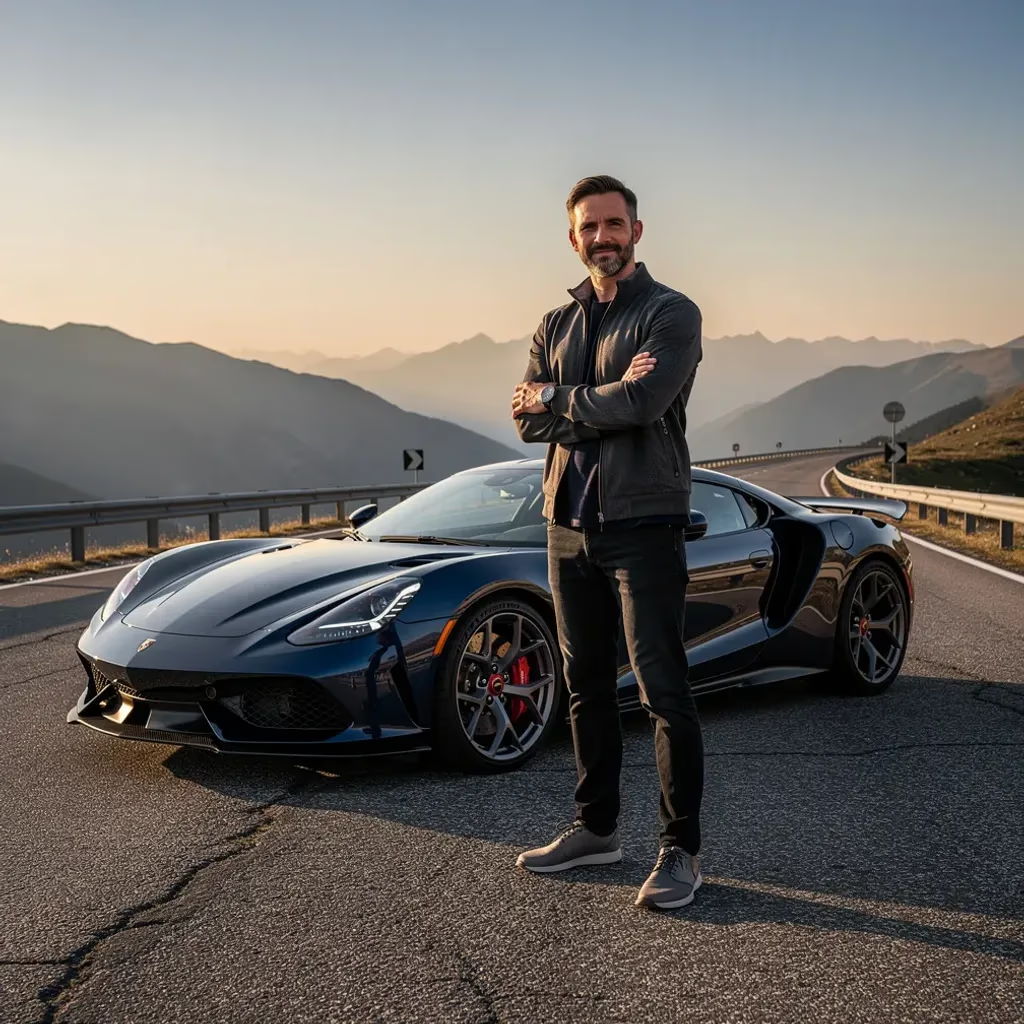
There's a reason certain cars feel like you the moment you sit in them - and a reason others, no matter how practical or impressive, feel like a costume you can't quite pull off. That's not about brand loyalty or price range. It's about energy alignment: the match between how you actually move through the world and what your vehicle communicates about that.
The Drive Your Style quiz free identifies which of 6 core Drive Types maps to your actual operating pattern - not your aspirational one. Taking 3 minutes to answer honestly about what car suits my personality reveals something most men have never had language for: why certain choices drain you, why specific environments sharpen you, and what vehicle truly fits the engine you're actually running.
This isn't about what car looks impressive at a stoplight. It's about what vehicle matches the real you - the one making decisions at 2am, the one under pressure, the one who already knows something is off but hasn't had a map for it yet.
The 6 Drive Types:
The Maverick
- What it looks like: High autonomy, innovation-first, flow-oriented, authenticity as the highest value
- Key signs: You gravitate toward the unconventional choice even when you can't fully explain why; the standard recommendation always feels slightly off
- What it means: Your pattern isn't contrarianism - it's a precision filter that rejects what doesn't fit
The Commander
- What it looks like: Decisive, power-driven, precision-focused, tradition-aware, connection-capable
- Key signs: You make fast calls, you feel the weight of responsibility, and soft consensus approaches frustrate you
- What it means: Your engine runs on clarity and authority - and the right vehicle communicates that without apology
The Architect
- What it looks like: Autonomy-driven, innovation-oriented, precision-focused, power-competent
- Key signs: You notice design flaws others miss, you plan several moves ahead, and "good enough" feels like a personal insult
- What it means: Your standards aren't perfectionism - they're pattern recognition operating at a level most people can't see
The Guardian
- What it looks like: Connection-driven, tradition-anchored, harmony-seeking, precision-capable
- Key signs: Reliability isn't a compromise to you - it's a core value; the vehicle that fails someone depending on it is a serious problem
- What it means: Your energy is about building something trustworthy, and the right car signals exactly that
The Pathfinder
- What it looks like: Autonomous, authenticity-first, flow-oriented, innovation-leaning
- Key signs: You want the vehicle that fits your actual life - the trails, the early mornings, the routes nobody else takes
- What it means: You're not running from commitment; you're running toward alignment
The Diplomat
- What it looks like: Connection-driven, harmony-seeking, authenticity-oriented, flow-capable
- Key signs: You read rooms and adjust naturally; the vehicle that creates friction in relationships or makes someone uncomfortable matters to you
- What it means: Your social intelligence is an asset - the right car works with that energy, not against it
What makes this quiz different from anything else asking what car suits me quiz:
Most car quizzes match you to a brand or body style based on lifestyle preferences. This one measures 10 underlying psychological dimensions - including rare bonus factors like your risk tolerance, sensation seeking, mastery orientation, and self-trust under ambiguity - that no standard personality quiz captures. That combination is what makes your result feel precise instead of generic.
5 Things That Shift When You Know Your Drive Type

Understanding what car suits your personality goes well past the parking lot. Here's what actually changes:
- Recognize why certain decisions have felt like driving on the wrong road - not failure, just misalignment between your actual operating pattern and the environment you were in
- Identify the precise tension between what you've been performing and what you actually run on - and stop burning energy on the gap
- Figure out which environments, roles, and challenges are built for your Drive Type - so you stop copying strategies designed for a completely different engine
- See the specific stress signals your Drive Type throws when it's out of alignment - what car suits me quiz reveals these patterns before they cost you
- Build a clearer picture of what "aligned" actually looks like in practice: the work contexts that energize you, the decision style that plays to your strengths, the vehicle aesthetic that actually fits
Kyle's Story: The Thing My Car Already Knew

I've driven the same car for six years. Sensible choice, everyone said so at the time. Reliable. Good resale value. Low running costs. Practical.
I'm 38, operations manager at a mid-size logistics company. My job is essentially making sure that all the moving parts move. Routing, scheduling, team coordination, getting things across the line without drama. I think three steps ahead on instinct at this point. Been doing it long enough that it's just how my brain works.
On paper, a practical car makes complete sense for a person like me. Of course it does.
In practice, every time I've driven something with real power under it - a buddy's truck, a rental I got upgraded into once on a trip out west, even a company vehicle I borrowed for a site visit last spring - something changes. Not a huge thing. More like a setting I forgot was adjustable getting nudged. Less like I'm transporting myself somewhere and more like I'm actually driving somewhere. Less administrator, more... I don't know. Just more.
I'd noticed this pattern for years and never examined it. It felt too trivial to examine. I drive, it works, I get where I'm going, end of conversation.
Then Evan sent me the quiz. He's 35, been on a bit of a self-discovery kick since his birthday last year. Started reading about personality types, took every quiz he could find, kept forwarding them to me with minimal context. He texted the link with: "Just take it. Probably something there."
I almost ignored it. I wasn't in the mood for another "discover your authentic self" thing that tells you something vague and makes you feel marginally better for a few minutes before you forget about it. But it was a Wednesday evening and I was sitting in the parking garage after a grinding day, not quite ready to start the drive home yet, just sort of... stalling. So I pulled out my phone and started it.
The quiz was better than I expected. The questions weren't obvious. They weren't asking "do you prefer adventure or security?" They were asking things about how you make decisions under pressure, what you do with downtime, how you'd describe your relationship with routine. I found myself actually thinking about some of them instead of just clicking through.
Twenty minutes later I had results.
The quiz put me as a Commander type. Which apparently means - and I'm going off memory here because I read the results a few times and I'm still not sure I've got every nuance - that my natural mode is about direction and agency. Not just managing systems and keeping things running efficiently. Something about how I actually process the world is fundamentally about control over outcomes, not just maintenance of processes.
I sat with that for a moment because it wasn't what I'd have said about myself, and also because it was kind of exactly right in a way I couldn't immediately explain.
The car part was where it got specific. The quiz laid out something I'd never quite thought through. Commander types tend to default to conservative, "smart on paper" choices in the visible parts of their lives - the car, the apartment, the wardrobe. The reasoning: they're already running high cognitive load elsewhere, and the last thing they want is to look like they made a questionable call in something as public as a car. But what they're actually wired for is agency. The kind of driving experience that responds to input. Something that feels like an exchange between driver and machine, not just transportation from A to B.
I read that section twice.
Then I thought about six years in the sedan. And every road trip or errand where I'd borrowed someone else's truck and felt inexplicably more awake at the wheel. And the specific mood I'd been in when I picked my current car - I was two months into a new role, trying to look like someone who had his life together, and "practical and reliable" seemed like the signal to send.
That's a different reason for choosing a car than "this is what I actually want."
I started noticing patterns after that. Not in a dramatic way. Just... paying attention differently.
How many of my choices in the last few years had been optimized for "no one can criticize this" instead of "this is actually what I want"? Not wrong choices, most of them. I'd made pretty good calls overall. But there was a version of me that had been defaulting to the defensible option in a lot of situations where the defensible option and the right option weren't quite the same thing.
The watch I'd worn for three years that I'd never actually liked but had bought because it was objectively a "good watch." The apartment I'd signed a lease on because the commute made sense on paper, not because I liked the apartment. The route I'd started driving to work that was actually three minutes longer but felt better - and then switched back to the "faster" one because it seemed more efficient.
Small things. But a pattern of small things.
A week after I took the quiz, I was on the phone with Mia. She's 40, my ex, and we're in decent contact - we ended things two years ago on good terms and have kept a loose friendship going. She'd mentioned something years back, during one of our longer road trips together, that I always seemed like I was waiting for something. I'd brushed it off. "Just thinking," I'd said.
I told her about the quiz. What the Commander type thing said. The car insight specifically.
She was quiet for a second.
"You know how you'd get on road trips?" she said. "That look where you finally had room."
I knew exactly what look she meant and I hadn't thought about it in months.
"Yeah," I said.
"I always thought that was just you relaxing. But it was more than that, wasn't it."
It wasn't really a question.
I'm not the kind of person who goes out and impulse-buys something because of an online quiz. That's not how I'm wired and it wouldn't be smart. But I did start looking differently at what I was driving and why, and what I actually wanted the next one to be when my lease ran out.
I test-drove something different about three weeks later. Just to calibrate, I told myself. Just data-gathering.
Took it on the highway north of the city. Not aggressive about it. Just drove it the way I'd actually drive a car day to day - highway merge, some open road, a bit of traffic on the way back.
The response was different. I wasn't managing it. I was driving it.
I noticed I wasn't thinking about work the whole time. That almost never happens on a drive. My brain's usually still running logistics somewhere in the background, half on whatever I'm going to handle when I get home. That drive I was just... present. Paying attention to the road, the feel of the thing, the straightforward fact of moving.
Evan asked how the test drive went.
"Turns out the quiz was onto something," I told him.
He did not let that go for approximately two weeks.
I'm still in the same car. Eleven more months on the lease. Nothing dramatic has changed.
But I've got an idea of what I want next, and it's not the next sensible choice on paper. And I've started catching myself in other areas too - the moment where I'm about to default to the defensible option and I notice it happening. Sometimes I override it. Sometimes the practical choice still wins and that's fine.
But at least now I can see when I'm doing it.
Commander type. I don't know if that's exactly right for every corner of who I am. I'm still turning it over. But the car thing was specific enough, and accurate enough, that I'm paying attention.
That's something. Not everything, but something. More than I had before I took the quiz on a Wednesday in a parking garage because I didn't want to drive home yet.
- Kyle W.,
All About Each Drive Type
| Drive Type | Also Called |
|---|---|
| The Maverick | The Independent Innovator, The Non-Conformist, The Autonomous Creator, The Unconventional Force |
| The Commander | The Decisive Leader, The Power Driver, The Strategic Authority, The Results-Focused Captain |
| The Architect | The Strategic Visionary, The Precision Builder, The Systems Thinker, The Master Designer |
| The Guardian | The Reliable Protector, The Steadfast Anchor, The Dependable Enforcer, The Trust Builder |
| The Pathfinder | The Authentic Explorer, The Route Finder, The Independent Adventurer, The Purposeful Rover |
| The Diplomat | The Collaborative Bridge-Builder, The Harmony Driver, The Social Navigator, The Unity Creator |
Am I a Maverick Drive Type?

If you've ever stood in a dealership genuinely considering the one vehicle nobody else seems to understand - the one that doesn't fit the standard narrative for your income bracket or social circle - you already have a sense of what the Maverick pattern feels like. It's not rebellion for its own sake. It's a precision-calibrated internal compass that consistently rejects the off-the-shelf option and reaches for the one that actually fits.
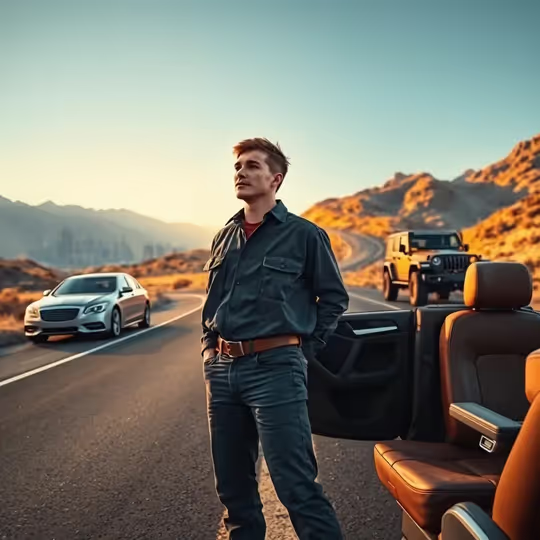
Men who score as The Maverick typically carry a quiet frustration with recommendations. Not because they're difficult, but because their operating pattern genuinely diverges from what the mainstream recommends. The car that "everyone" says makes sense for a guy in his position feels like a costume. Wearing it is exhausting in a specific way: you look fine from the outside, and nobody can see the mismatch that you feel on every drive.
The Maverick pattern is one of the least understood Drive Types precisely because from the outside, it can look like pickiness, impracticality, or even status-avoidance. What's actually happening is a high-resolution filter running constantly - one that's measuring authenticity-fit rather than approval-fit. When those two things align, the Maverick is energized. When they don't, the drain is real and cumulative.
The Maverick Drive Type: What's Actually Going On
The Maverick's core engine runs on autonomy and authenticity operating simultaneously. This is rarer than it sounds: plenty of men run high on autonomy but optimize for status rather than internal alignment. The Maverick runs both - which means every choice, including vehicle choice, gets measured against two internal standards: "Does this serve my direction?" and "Does this actually fit who I am?"
The psychological mechanism here is what researchers describe as identity-based decision filtering. Rather than evaluating options against external benchmarks (what would look impressive, what's practical by consensus), Mavericks run a parallel evaluation against internal benchmarks. This produces faster, more confident decisions in domains where they have strong self-knowledge - and visible friction in domains where others expect consensus-based choices.
This pattern typically develops from early experiences where following the standard path produced genuine mismatches. Rather than adjusting the compass to point elsewhere, the Maverick learned to trust the compass. That trust is the foundation of the type. Autonomy became the protection, innovation became the mechanism, and authenticity became the standard.
The nervous system reality: Mavericks often experience physical discomfort in high-conformity situations. It's not social anxiety - it's a trained alert signal that fires when the mismatch between internal direction and external expectation exceeds a threshold. The relief that comes from making an aligned decision is equally physical: a kind of settling, clarity, rightness.
What The Maverick Looks Like
- Preference drift under observation: You know what car suits your personality privately. You've sensed it for years. Put you in a dealership with someone whose approval matters and the answer gets muddier. The Maverick pattern is clearest when no one's watching - and most compromised under social pressure.
- Authentic exhaustion from performed choices: The car you bought because it made sense to others - the sensible sedan, the approved pickup - costs you every time you get in it. Not because the vehicle is bad, but because the misalignment is a constant low-grade friction. Mavericks feel this as a specific kind of draining.
- Speed and certainty in aligned decisions: When a vehicle genuinely matches the Maverick's energy, the decision isn't slow or agonized. It arrives fast and settles completely. Men with this pattern often describe their best vehicle purchases as "I just knew" - not intuition exactly, but clarity.
- Resistance to trend-based choices: The Maverick is not immune to what looks good. But trend-based purchases that don't fit the internal map feel like wearing a uniform: fine for appearances, wrong for performance.
- High innovation pull: The unconventional powertrain, the emerging brand, the category-defying body style - Mavericks track these before they go mainstream, not for contrarianism but for genuine alignment with their forward-oriented pattern.
- Authenticity as a non-negotiable: There's a baseline for the Maverick below which no amount of external approval compensates. A vehicle that scores high on status but low on personal fit will be outperformed by a less obvious choice that actually resonates.
- Sensation seeking in specific contexts: Not all Mavericks are speed junkies. But most score meaningfully on sensation seeking as a secondary dimension - meaning they respond to intensity, to the feedback loop of a capable vehicle, to the physical information a well-tuned machine provides.
- Discomfort with over-managed experiences: The Maverick wants to feel the road, understand the machine, access the performance. Vehicles that over-insulate, that layer too many automated systems between driver and experience, create the opposite of alignment.
- Self-trust under uncertainty: One of the Maverick's clearest characteristics is the willingness to commit to an unconventional choice without needing external validation. This isn't arrogance - it's a well-developed relationship with one's own judgment.
- Risk tolerance as a genuine feature: Mavericks consistently score higher on risk tolerance than Guardians or Diplomats. They factor risk into decisions but aren't stopped by it. The unconventional vehicle choice is a reasonable risk if the alignment is high.
- Flow-orientation in execution: Mavericks chafe under rigid processes. They need to find their own rhythm, their own line through the course. Vehicles that reward this - that respond to driver input, that punish mechanical autopilot - are the ones that energize rather than drain.
- Independent self-concept: The Maverick's identity is not primarily shaped by group membership or role. This is a feature. It also means that fitting in for its own sake has limited appeal - and vehicles chosen for belonging rather than fit will always feel slightly wrong.
How The Maverick Operates Across Different Domains
In relationships: Mavericks bring full attention and genuine presence to relationships they've chosen. The challenge is that they don't perform compatibility - they either are compatible or they're not, and they know it quickly. Partners who understand this find Mavericks deeply committed. Partners who read the Maverick's selectivity as distance sometimes try to fill the gap with reassurance-seeking, which creates a dynamic the Maverick doesn't naturally understand.
In professional settings: Mavericks tend to excel in environments that reward independent judgment and original thinking - and underperform in environments that prioritize compliance and consensus. The awareness of which environment you're in is often missing until the frustration becomes significant. Knowing your Drive Type gives you this diagnostic before it costs you two years in the wrong role.
In friendships: Maverick-type men form fewer but more genuine friendships. The standard male friendship pattern - affiliation through shared activities with limited direct communication - works for them only up to a point. Friendships with men who have similar Drive Types or high self-trust scores feel notably different: more direct, less performance-based.
Under pressure: The Maverick's stress response tends toward isolation and increased self-reliance. Under significant pressure, the external pattern-filtering intensifies, which can look like withdrawal or stubbornness. Understanding this as a pressure response rather than a character flaw changes how you manage high-stakes periods.
Situations That Activate The Maverick Pattern
- Being required to defend an unconventional choice to people whose approval you didn't ask for
- Environments where consensus is the primary decision filter and individual judgment is treated as a problem
- The moment you realize the choice you made for others is costing you every single day
- High-conformity professional or social contexts where the Maverick's pattern stands out as non-standard
- Feeling out of alignment with your own stated values because you made the "sensible" choice
What To Do With This
- This isn't about fixing the pattern: The Maverick's authenticity-filter and autonomy drive are genuine strengths. Understanding them means deploying them with intention - choosing where to optimize for alignment versus where to strategically meet consensus expectations.
- The vehicle question is a real diagnostic: Men who ask what car suits my personality and land on Maverick have a useful data point. What the answer reveals about decision-making patterns, tolerance for misalignment, and priority ordering has applications across every major life domain.
- Pressure-test your alignments periodically: Mavericks who don't regularly audit their life for accumulated conformity decisions find themselves exhausted for no visible reason. The audit is simple: what choices have I made for approval rather than fit?
- Your risk tolerance is an asset when managed well: Mavericks can make decisions others won't, which is a competitive edge. The discipline is in distinguishing high-conviction unconventional choices from novelty-seeking impulse.
- Men who understand this type report that once they stop apologizing for their compass, decisions get faster and results get better. The Maverick pattern works extremely well - when it's not fighting itself to fit a mold it was never built for.
Maverick High Performers
- Elon Musk (Entrepreneur/Engineer)
- Steve Irwin (Wildlife Conservationist)
- Kanye West (Artist/Designer)
- Anthony Bourdain (Chef/Author)
- Chris Rock (Comedian)
- Evel Knievel (Stunt Performer)
- Bear Grylls (Adventurer)
- Hunter S. Thompson (Journalist/Author)
- Matthew McConaughey (Actor)
- Jack White (Musician)
- Tim Ferriss (Author/Entrepreneur)
- Jeremy Clarkson (Automotive Journalist)
Maverick Drive Type Compatibility
| Drive Type | Match | Why This Pairing Works or Challenges |
|---|---|---|
| The Maverick | 😍 Dream team | Shared autonomy and authenticity values create rare mutual understanding without performance requirements |
| The Pathfinder | 🙂 Works well | Both value authentic direction over approval - differences in execution style create productive friction rather than conflict |
| The Architect | 🙂 Works well | Shared innovation drive and autonomy focus; tension can emerge when Architect's precision conflicts with Maverick's flow preference |
| The Commander | 😐 Mixed | The Commander's tradition-awareness and status-sensitivity can feel constraining to the Maverick's authenticity-first pattern |
| The Guardian | 😕 Challenging | Maverick's risk tolerance and novelty-seeking create ongoing friction with the Guardian's preference for the proven and stable |
| The Diplomat | 😐 Mixed | The Diplomat's harmony focus can read as social pressure to the Maverick - works when both understand the underlying difference |
Am I a Commander Drive Type?
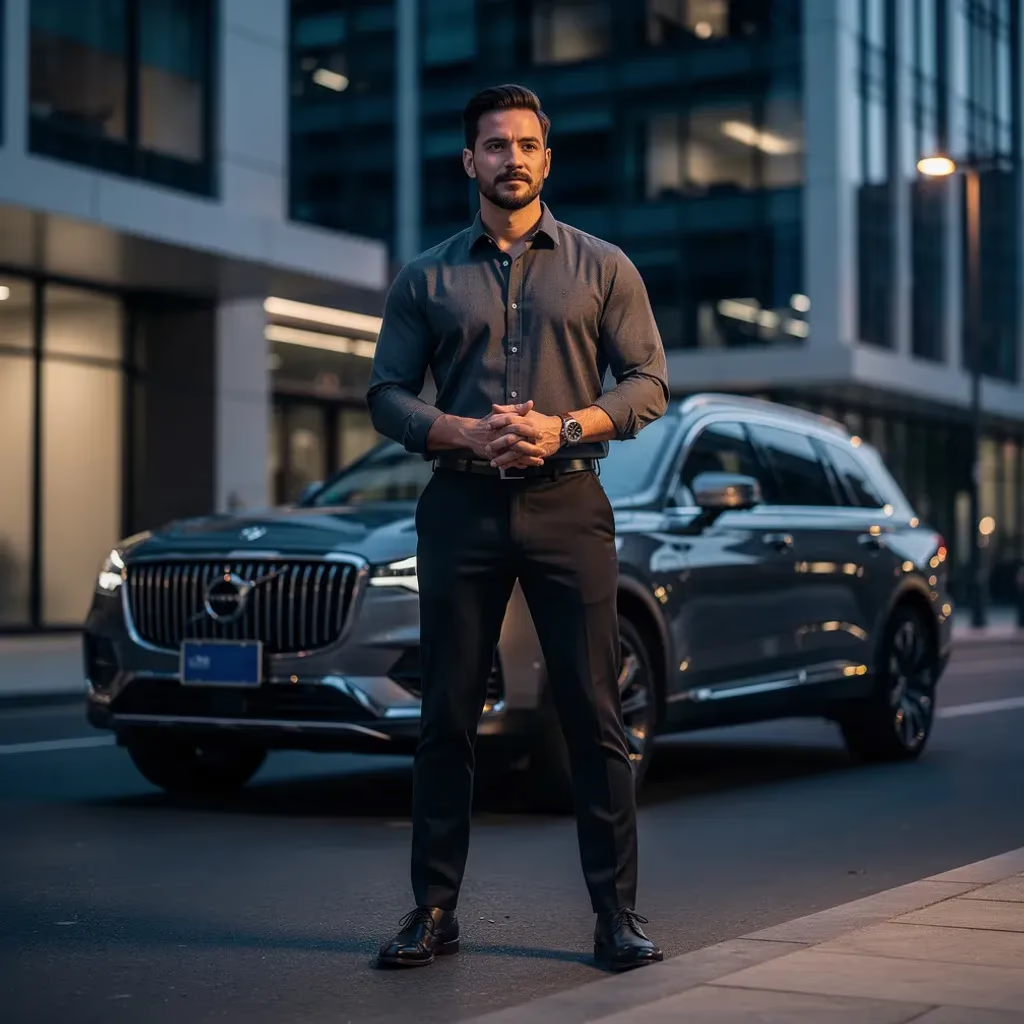
The Commander pattern shows up early. It's the guy who somehow ends up coordinating the group without officially volunteering, who makes the call when everyone else is deliberating, who feels the drag of indecision in others like a physical friction. He doesn't always look like the most aggressive person in the room - but he's almost certainly the one who's already identified the best move and is waiting for consensus to catch up.
Men who score as The Commander often carry a private frustration that looks like impatience but runs deeper: they can see what needs to happen, and the delay between clarity and action costs them energy. This isn't arrogance. It's a genuine mismatch between the Commander's decision speed - driven by high power, precision, and tradition-anchored judgment - and the consensus-heavy pace most modern environments require.
The vehicle choice for a Commander communicates something real. The under-spec'd choice isn't modesty - it's misalignment that every person who knows you well notices, even if they can't name it. The right vehicle doesn't signal dominance for its own sake. It signals that the man behind the wheel has standards, makes decisions, and knows exactly what he's doing.
The Commander Drive Type: What's Actually Going On
The Commander's core engine runs on power and precision operating together, grounded by a strong tradition orientation. This combination produces a distinctive decision-making profile: fast, confident calls built on accumulated knowledge of what actually works rather than what's theoretically optimal.
The psychological mechanism here is what researchers describe as authority-grounded judgment. Commanders don't need consensus to feel confident in a decision - they've developed robust internal references from experience, observation, and pattern recognition. The tradition orientation functions as a quality filter: proven approaches earn weight, untested innovations require evidence before they get traction.
This pattern typically develops through early success in environments that rewarded clear thinking and decisive execution. The Commander learned that hesitation has costs, that clarity produces respect, and that carrying responsibility is a feature rather than a burden. The result is an energy pattern that naturally gravitates toward leadership roles, high-stakes decisions, and environments where output matters more than process.
The nervous system reality: Commanders experience physical discomfort in high-ambiguity situations where clear answers are unavailable - not because uncertainty is threatening, but because inaction feels like a misuse of capacity. The relief from making a clear decision is immediate and physical. This is the engine: it wants to run.
What The Commander Looks Like
- Decision speed as a default: The Commander doesn't deliberate equally on all options. He identifies the viable path quickly and commits with full attention. Men with this type often describe their decision process as fast but not impulsive - there's internal criteria running that others can't see.
- Responsibility as a natural load: Commanders pick up responsibility in their environment automatically. It's not performance - it's a genuine orientation toward carrying what needs carrying. The vehicle that fails a responsibility (doesn't start reliably, presents poorly in professional contexts) is a real problem, not just an inconvenience.
- Status-awareness without status-obsession: The Commander is aware of how vehicles communicate in professional and social contexts. This isn't shallow - it's situational intelligence. Choosing the vehicle that undermines credibility is genuinely costly in contexts where the Commander operates. The right choice projects the right signal.
- Precision in execution: Commanders are frustrated by sloppiness, in vehicles and everywhere else. A car that's close to what's needed but off in important ways is more irritating than a clearly wrong choice. It's the almost-right that costs.
- Tradition orientation as quality filter: The proven engineering, the marque with a long performance record, the vehicle class that has earned its reputation - these carry genuine weight for a Commander. Not because new things are bad, but because the Commander has learned to read evidence of sustained quality.
- Connection-capable without connection-dependent: Unlike the Diplomat or Guardian, Commanders don't need connection to function - but they're not disconnected from it either. The Commander can build loyalty and bring people with them because their decisiveness creates safety for others. The right vehicle supports this: it doesn't isolate, but it doesn't require group approval either.
- Power-orientation in motion: The Commander driving a vehicle that can't deliver on demand is a genuine mismatch. The engine response, the acceleration headroom, the weight of the vehicle on the road - these are physical inputs the Commander registers as alignment or misalignment.
- Strategic status management: Commanders understand that vehicle choice is a communication. They don't choose to impress strangers - they choose to signal accurately to the people whose judgment matters in their professional context.
- Leadership by default: Commanders don't announce leadership. They assume it when the environment requires it and exercise it precisely. A vehicle that communicates competent authority rather than aggressive posturing is the one that matches this energy.
- Mastery orientation: Commanders invest in understanding what they operate. The vehicle is not a mystery to be managed - it's a system to understand and run well. High mastery orientation scores in this type are common.
- Achievement drive: Results matter specifically. The Commander tracks performance - vehicle performance, personal performance, professional performance - as a baseline, not a special effort.
- Emotional regulation as a core skill: The Commander's composure under pressure isn't suppression - it's a trained capacity to downshift reactivity and stay deliberate when stakes are high. This is one of the bonus variables this quiz measures that standard personality tests miss entirely.
How The Commander Operates Across Different Domains
In relationships: Commanders are stable, consistent, and genuinely reliable as partners and friends. The challenge is that their decisiveness can read as control if the other person hasn't established clear communication. Commanders who learn to distinguish between decisions that require input and decisions they can own unilaterally tend to have significantly better relationship outcomes.
In professional settings: The Commander's natural domain. High performance environments, clear accountability structures, and measurable outcomes are where this type runs cleanest. The frustration point is bureaucratic environments where output is secondary to process - which the Commander experiences as a system actively preventing good results.
In friendships: Commander-type men maintain smaller circles with high reliability standards. They're not demonstrative in friendship - but they show up consistently, remember what matters to their people, and can be counted on in a crisis. The friendships that work best for Commanders are peer-based: other capable men, mutual respect, low maintenance.
Under pressure: The Commander's stress response is to simplify and execute. Under significant pressure, the decision speed increases and the tolerance for ambiguity decreases. This is effective in genuine crises and can create friction in situations that aren't actually emergencies but feel like one.
Situations That Activate The Commander Pattern
- Group decision processes that move slower than the problem requires
- Environments where political considerations override clear performance-based calls
- Being second-guessed on decisions that were clearly correct
- High-stakes situations where the right vehicle matters for professional credibility
- Watching someone perform leadership without actually exercising judgment
What To Do With This
- Your decision speed is an asset, not a flaw: The Commander's fast, confident call-making is a genuine advantage in environments that reward it. The skill is identifying which contexts require that speed and which require you to slow the pace for buy-in.
- The right vehicle matters in ways that are legitimate: Commanders sometimes second-guess the importance they place on vehicle quality and signal. The awareness that this matters is accurate - the question is whether the specific choice is serving your actual professional and personal context.
- Your tradition-orientation is a quality filter, not conservatism: Choosing the proven over the unproven isn't resistance to change. It's applying the standard you use everywhere - evidence of sustained performance - to vehicle selection. That's reasonable.
- Manage the frustration tax: Commanders in mismatched environments accumulate a specific frustration - watching the right answer not be taken. Understanding this as a Drive Type feature, not a personal failing, helps you budget your energy better.
- Men who understand their Commander pattern typically report faster, less conflicted decisions across major life domains, once they stop apologizing for the standards they already operate by.
Commander Leaders and Achievers
- Tom Brady (Athlete/Entrepreneur)
- Denzel Washington (Actor)
- David Goggins (Athlete/Author)
- Kobe Bryant (Athlete)
- Roger Federer (Athlete)
- Clint Eastwood (Actor/Director)
- General Colin Powell (Military Leader)
- Phil Jackson (Coach)
- Jeff Bezos (Entrepreneur)
- Jocko Willink (Military Leader/Author)
- Arnold Schwarzenegger (Athlete/Actor)
- Lee Iacocca (Automotive Executive)
- Michael Jordan (Athlete/Businessman)
Commander Drive Type Compatibility
| Drive Type | Match | Why This Pairing Works or Challenges |
|---|---|---|
| The Commander | 😍 Dream team | Mutual understanding of standards, responsibility, and decisive execution creates high-functioning alignment |
| The Architect | 🙂 Works well | Shared precision and power orientation; Architect's analytical depth complements Commander's execution speed |
| The Guardian | 🙂 Works well | Commander's decisive direction and Guardian's reliable follow-through create a strong operational pairing |
| The Maverick | 😐 Mixed | Commander's tradition-anchored judgment and status-awareness create periodic friction with Maverick's authenticity-first filter |
| The Pathfinder | 😐 Mixed | Pathfinder's exploratory orientation and flow-preference can feel unfocused to the Commander's precision and results drive |
| The Diplomat | 😕 Challenging | Commander's power-orientation and fast decision-making can override the Diplomat's harmony-seeking and deliberate consensus process |
Am I an Architect Drive Type?
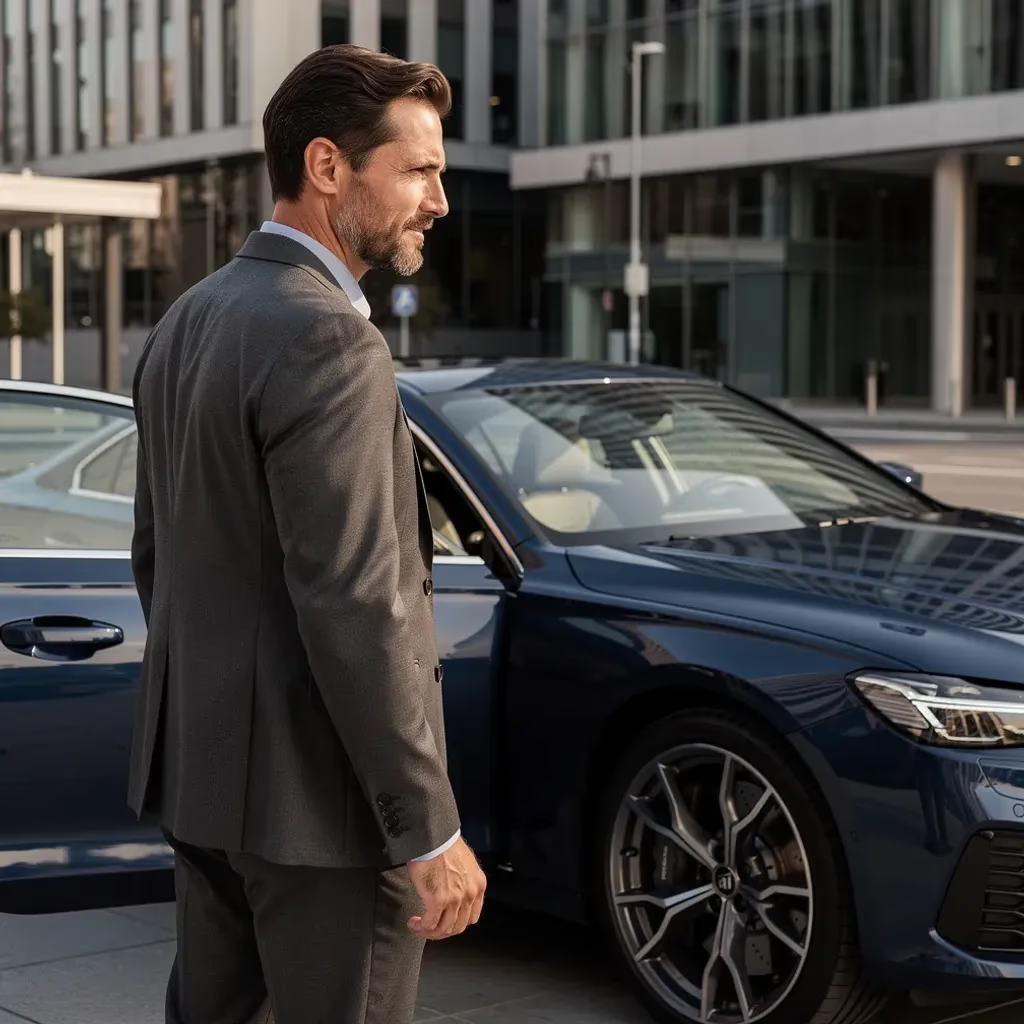
The Architect sees the vehicle before anyone else has finished talking. While others are weighing brand reputation and monthly payments, the Architect has already mapped the engineering, identified three weaknesses in the current generation's suspension tuning, and quietly calculated the depreciation curve versus the real cost of ownership. It's not showing off. It's just how the pattern runs.
Men who score as The Architect carry a specific frustration: their level of analysis is often read as overthinking, when what's actually happening is the pattern recognition operating exactly as it should. The gap between the analysis they're running internally and the simplified version they communicate externally creates a kind of permanent translation cost. The right vehicle is one that rewards this level of engagement rather than resisting it.
What the Architect needs from a vehicle isn't different in kind from what other men need - it's different in precision. The system needs to hold up under scrutiny. The engineering decisions need to be defensible. The performance characteristics need to deliver what they promise. The Architect isn't buying a vehicle. He's buying a system he can trust to run correctly.
The Architect Drive Type: What's Actually Going On
The Architect's core engine runs on autonomy and innovation simultaneously, channeled through a high precision orientation and a significant power drive. This produces the distinctive Architect profile: independent, forward-thinking, standards-based, and capable of sustained engagement with complex systems.
The psychological mechanism here is what's described as systems-level pattern recognition. Architects don't evaluate options linearly - they evaluate entire systems, mapping inputs, outputs, failure modes, and optimization pathways simultaneously. This is genuinely different from careful thinking or thoroughness. It's a cognitive style that processes at a different level of abstraction.
This pattern typically develops from early environments where precision and understanding were rewarded - or from early environments where imprecision had visible costs. Architects learn that understanding how something actually works is a competitive advantage, not a nerd hobby. That conviction becomes the pattern.
The nervous system reality: Architects experience genuine discomfort when operating systems they don't understand. Not anxiety - a specific kind of cognitive restlessness that resolves when the system is properly mapped. The vehicle that remains opaque, that can't be fully understood, creates a sustained low-level friction.
What The Architect Looks Like
- Pre-purchase research depth that looks excessive: The Architect doesn't over-research from insecurity. He researches because incomplete understanding is its own kind of risk. The research ends when the map is complete, not when a decision feels comfortable.
- Precise standards that aren't perfectionism: There's a difference between perfectionism (anxiety-driven elevation of standards past utility) and precision (accuracy-driven maintenance of standards at appropriate levels). Architects operate in the latter. The standard exists because it tracks something real.
- Innovation pull toward the engineering-first choice: The newest platform, the most advanced powertrain, the engineering decision that sacrifices short-term comfort for long-term performance advantage - these register to the Architect as clearly correct, not risky.
- Autonomy in decision-making: Architects rarely need external validation for technical decisions. They've done the work. The conclusion is defensible. Whether others agree is less important than whether the reasoning is sound.
- Strategic thinking across time horizons: The Architect is evaluating vehicle purchases across a 5-7 year window automatically. Total cost of ownership, reliability trajectory, resale value curve, likely technology shifts - all of this is running in parallel with the primary evaluation.
- Discomfort with performance that doesn't match specification: Vehicles that promise more than they deliver are a specific kind of irritant to the Architect. The gap between advertised performance and delivered performance is a trust failure, not just a disappointment.
- Mastery orientation as a core trait: Architects don't just want to own a capable vehicle - they want to understand it. The connection between driver input and vehicle response should be clear, learnable, improvable.
- Power-drive toward effective agency: The Architect's power orientation isn't about dominance - it's about effectiveness. The right vehicle is one that gives precise, reliable responses to precise, deliberate inputs. Anything less is an information-loss system.
- Self-trust under ambiguity: When the conventional wisdom and the Architect's analysis diverge, the Architect backs the analysis. This is the feature that produces outlier decisions - and occasionally the ones that prove correct years before anyone else reaches the same conclusion.
- Strategic thinking as automatic: Long-range planning, pattern identification, feedback loop analysis - these happen automatically for Architects, not as deliberate effort. They're looking for vehicles that support this mode, not fight it.
- Precision versus consensus: The Architect will defend an unconventional choice not from contrarianism but from having done the analysis. The choice that scores highest on an external metric that isn't measuring what the Architect is measuring is a bad choice, regardless of consensus.
- Forward orientation: Architects consistently track emerging technology, next-generation platforms, and category shifts. They want to understand what's coming, not just what's available.
How The Architect Operates Across Different Domains
In relationships: Architects bring genuine analysis and reliability to relationships. The challenge is that their communication often runs at a different level of abstraction than their partners are expecting - clear and precise from the Architect's perspective, sometimes missing emotional register from the other side. Understanding this translation requirement is one of the Architect's key growth points.
In professional settings: The Architect excels wherever deep thinking and long-range planning are valued. They struggle in environments where politics, optics, and consensus override analytical quality. The awareness of which environment you're in - and whether it's one where your Drive Type actually wins - is often the missing piece.
In friendships: Architects tend toward peer-based, competence-respecting friendships. They're reliable, honest, and intellectually engaged friends - but not emotionally demonstrative. The friends who work best for Architects are the ones who respect the analytical mode rather than reading it as cold or distant.
Under pressure: The Architect's stress response is to go deeper into analysis. Under genuine pressure, this can be extremely effective - the problem gets mapped correctly and the optimal path identified. The failure mode is analysis paralysis: continuing to refine the map past the point where the first available clear answer should have been taken.
Situations That Activate The Architect Pattern
- Being asked to make a consequential decision with incomplete information
- Environments where speed is valued over accuracy and the Architect's thoroughness is treated as a problem
- Watching a decision get made on insufficient data because consensus felt more important than correctness
- The moment when a vehicle or system fails in a way the Architect predicted but couldn't prevent
- Opportunities to evaluate a genuinely new platform with interesting engineering decisions
What To Do With This
- Your analysis level is an asset, not a liability: The Architect's deep evaluation of complex systems is genuinely valuable - in vehicles and everywhere else. The work is in deploying it effectively: knowing when to complete the analysis and act rather than continuing to refine.
- The right vehicle is the one that rewards your level of engagement: The Architect asking what car suits me quiz and landing here has a clear direction: precision engineering, genuine performance, systems you can actually understand and master.
- Manage the gap between your analysis and others' comfort with it: Architects routinely have the right answer earlier than others can see it. The translation cost - simplifying the reasoning enough for others to follow - is real. Understanding this as a Drive Type feature rather than a communication flaw changes how you manage it.
- The Architect who learns to act on sufficient analysis (rather than complete analysis) consistently outperforms the one still mapping the terrain while others have already moved. The analysis doesn't stop being useful. It becomes more useful when it's paired with decisive execution.
Architect Leaders and Achievers
- Jeff Goldblum (Actor/Musician)
- Nikola Tesla (Inventor)
- Leonardo da Vinci (Polymath)
- [Musk wasn't here] Neil deGrasse Tyson (Astrophysicist)
- Christopher Nolan (Filmmaker)
- David Lynch (Director)
- Quentin Tarantino (Director/Writer)
- Bill Nye (Science Communicator)
- Steve Wozniak (Engineer/Co-founder)
- [Walter White (Breaking Bad)] Bryan Cranston (Actor)
- Gordon Murray (Automotive Designer)
- Ferdinand Porsche (Engineer/Designer)
Architect Drive Type Compatibility
| Drive Type | Match | Why This Pairing Works or Challenges |
|---|---|---|
| The Architect | 😍 Dream team | Shared precision standards and systems-level thinking create genuinely complementary collaboration |
| The Commander | 🙂 Works well | Architect's analytical depth and Commander's decisive execution are complementary - each supplies what the other lacks |
| The Maverick | 🙂 Works well | Shared autonomy and innovation orientation create alignment; flow vs. precision creates occasional productive friction |
| The Pathfinder | 😐 Mixed | Both value authenticity and autonomy but Architect's precision standards can feel constraining to the Pathfinder's explorative flow |
| The Guardian | 😐 Mixed | Guardian's tradition-first approach creates friction with Architect's innovation drive - useful when both understand the complementarity |
| The Diplomat | 😕 Challenging | Architect's analytical mode and independence can feel disconnected from the Diplomat's harmony and connection-first priorities |
Am I a Guardian Drive Type?
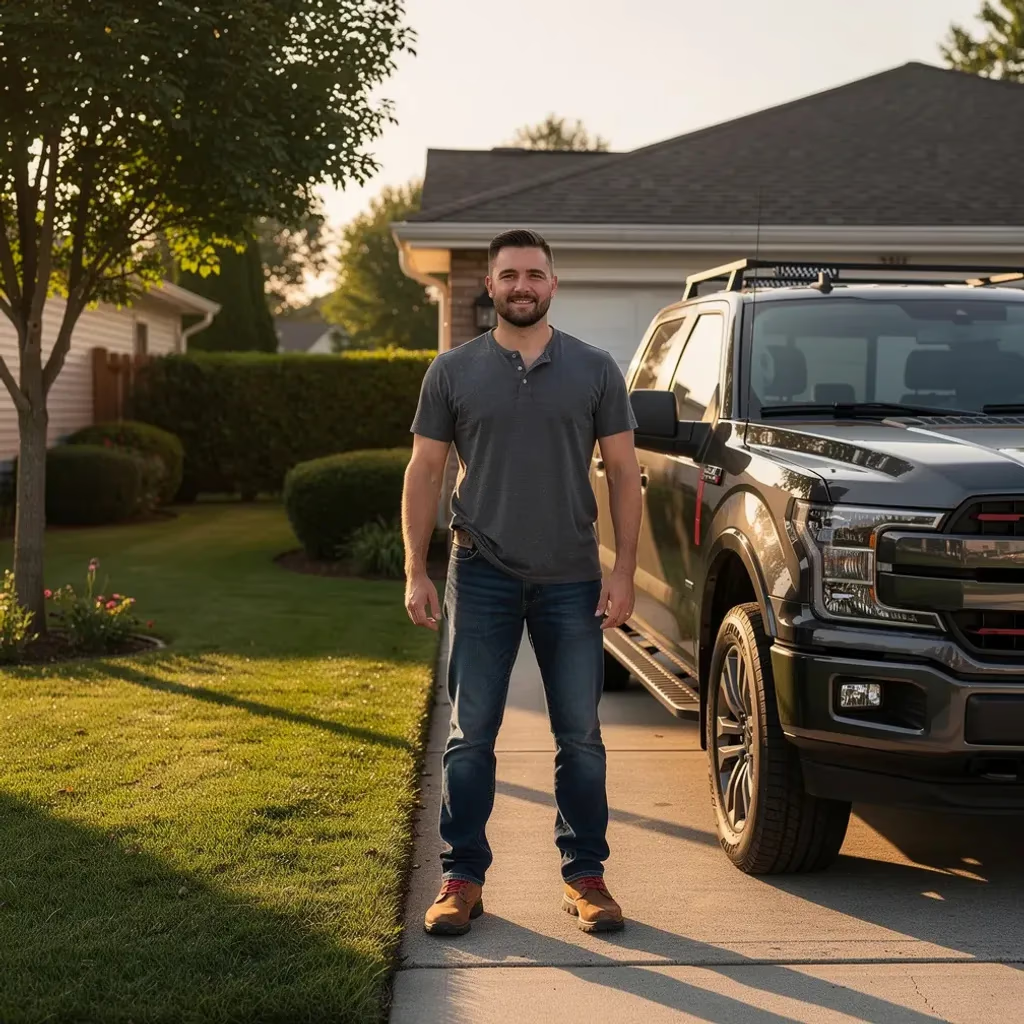
The Guardian pattern is probably the most underestimated Drive Type - not because it lacks substance, but because its substance is the kind that holds everything together rather than the kind that makes headlines. The Guardian is the man whose vehicle always starts, always shows up, always gets the job done without drama. And privately, he sometimes wonders if "reliable" is how other people say "boring."
It isn't. Understanding what car suits your personality as a Guardian means understanding that your core drive - connection, tradition, harmony, and precision - is the operational foundation that everything else runs on. The Maverick's freedom to explore? Enabled by Guardians who built infrastructure worth trusting. The Commander's decisive leadership? Sustained by Guardians who execute reliably in the background. The Guardian isn't the understudy. He's the architecture.
The vehicle question for a Guardian is real: not what looks impressive, but what actually holds up. Not what's exciting, but what's proven. And underneath that practical question is a deeper one: what vehicle fits a man who leads through reliability rather than charisma, who earns trust through consistency rather than performance, and who has spent most of his life being what everyone needs him to be?
The Guardian Drive Type: What's Actually Going On
The Guardian's core engine runs on connection and tradition simultaneously, grounded in a strong harmony orientation and genuine precision capability. This combination produces the most operationally consistent Drive Type: reliable judgment, sustained execution, and a genuine orientation toward the wellbeing of the people depending on them.
The psychological mechanism here is what researchers describe as reliability-grounded trust. Guardians don't build trust through charisma or brilliance - they build it through demonstrated consistency over time. The vehicle isn't purchased for its own sake. It's purchased in the context of what it means to the people depending on the Guardian, what it communicates about his standards, and how long it will actually perform.
This pattern often develops from early environments where being needed was a consistent experience. The Guardian learned that competence and reliability create safety for others - and that this matters. The pattern deepens over time as experience confirms that consistency produces better long-term outcomes than unpredictability.
The nervous system reality: Guardians experience genuine discomfort when reliability is compromised - their own or the systems they depend on. The vehicle that might not start on a critical morning, that might fail someone depending on them, is not just an inconvenience. It's a structural risk that activates the Guardian's protective pattern.
What The Guardian Looks Like
- Reliability as a genuine value, not a consolation prize: Guardians choose the proven option because proven performance is actually what they value. This isn't settling. It's prioritizing correctly given what matters to them.
- Connection through consistency: The Guardian's relationships are maintained through dependable presence. He's the one who remembers, who shows up, who follows through. The vehicle reflects this: it should be the one that doesn't let people down.
- Tradition as a quality signal: Established engineering, proven reliability records, long track records of performance - these carry genuine weight for Guardians. Not because they fear change, but because evidence of sustained performance is a legitimate quality signal.
- Service orientation in practice: Guardians score consistently high on service orientation - the drive to protect, help, and carry responsibility for others. This manifests directly in vehicle choice: the truck that can actually haul what needs hauling, the SUV that can carry everyone safely.
- Harmony-seeking in the vehicle context: The Guardian doesn't want a vehicle that creates friction - social, mechanical, or financial. The choice should feel right across all dimensions: in the family, in the budget, in the neighborhood, in the work context.
- Precision in maintenance: Guardians tend to maintain vehicles rigorously. The maintenance schedule isn't optional - it's how you honor the reliability that makes everything else possible.
- Achievement drive focused on sustained performance: Guardians track whether the vehicle is performing as it should, whether it's maintaining its capability, whether the investment is holding. Achievement for a Guardian is less about personal glory and more about things working correctly.
- Emotional regulation under pressure: The Guardian's calm under pressure is a genuine asset. When the vehicle breaks down, when plans go sideways, when reliability is compromised - the Guardian's response is systematic problem-solving rather than reactive panic.
- Connection-first decision making: Vehicle purchases for Guardians are made in the context of the people around them. The choice that makes sense in isolation but creates friction in the relationship is already the wrong choice.
- Strategic risk management: Guardians typically score lower on risk tolerance, which is a feature rather than a limitation. Their risk management capacity is what makes them excellent at building and maintaining structures others can count on.
- Mastery through sustained engagement: Guardians know their vehicles because they've maintained them over time. The mastery is cumulative and practical rather than theoretically deep.
- Belonging orientation: The Guardian's identity is meaningfully shaped by the groups he belongs to - family, team, community. The vehicle should fit those contexts, not create awkwardness within them.
How The Guardian Operates Across Different Domains
In relationships: Guardians are among the most reliable partners across all Drive Types. Their consistency, their follow-through, their genuine orientation toward the people they love - these are significant relationship assets. The challenge is the cumulative cost of being the reliable one: Guardians can absorb responsibility so consistently that they never give others the chance to show up for them.
In professional settings: Guardians excel in roles that reward sustained excellence, operational reliability, and trust-building over time. They're less suited to high-volatility environments that reward aggressive risk-taking. The awareness of this is important: not every professional environment will value what the Guardian brings, and knowing which ones do is worth developing.
In friendships: Guardian-type men are steadfastly loyal friends. They're not the most emotionally expressive, but they're the ones who remember what you told them six months ago and ask about it now. Friendships with Guardians tend to be long-term and genuinely reliable.
Under pressure: The Guardian's stress response is to lean harder into responsibility - to absorb more, carry more, make more certain that everything is covered. This can be a genuine strength in crisis and a slow drain in extended periods of high demand. Understanding the difference between situations that genuinely require the Guardian's capacity and situations where others need to carry their own weight is a key growth point.
Situations That Activate The Guardian Pattern
- Vehicle or system reliability failures that affect people depending on them
- Environments that reward novelty and risk-taking over proven performance and sustained reliability
- Being asked to carry responsibility for decisions they weren't consulted on
- The slow recognition that their pattern of absorbing responsibility isn't reciprocated
- Choosing between what they genuinely want and what makes the most sense for everyone around them
What To Do With This
- Your reliability is a genuine competitive advantage, not a consolation prize: The Guardian asking what car suits me best quiz and landing here has a real answer - vehicles that reflect sustained performance, practical capability, and proven engineering are genuinely the right fit. That's not boring. That's aligned.
- The service orientation is an asset when it's chosen rather than automatic: Guardians who understand their pattern can distinguish between genuine service (chosen, fulfilling, energizing) and automatic responsibility absorption (default, draining, taken for granted).
- Your tradition orientation isn't resistance to change: It's a legitimate quality filter. Proven performance is evidence. Choosing the proven option isn't playing it safe - it's applying appropriate evidence standards.
- Men who understand their Guardian pattern and start choosing authentically - including vehicles - report that the relief is significant. Discovering that 'reliable' was never a second-best choice, just one with a different engine under the hood, is genuinely clarifying.
Guardian Leaders and Achievers
- Warren Buffett (Investor)
- Keanu Reeves (Actor)
- Tom Hanks (Actor)
- Bruce Springsteen (Musician)
- Peyton Manning (Athlete)
- Fred Rogers (Educator/Broadcaster)
- John Wooden (Coach)
- Bryan Stevenson (Lawyer/Activist)
- Derek Jeter (Athlete)
- Fred Smith (Entrepreneur/FedEx Founder)
- Chip Ganassi (Racing Team Owner)
- Bob Parsons (Entrepreneur)
Guardian Drive Type Compatibility
| Drive Type | Match | Why This Pairing Works or Challenges |
|---|---|---|
| The Guardian | 😍 Dream team | Mutual reliability orientation and connection-first values create the most stable pairing across all Drive Types |
| The Diplomat | 🙂 Works well | Both value connection and harmony - Diplomat's social intelligence and Guardian's reliability create complementary strengths |
| The Commander | 🙂 Works well | Guardian's sustained execution and Commander's decisive direction create a high-functioning operational pairing |
| The Pathfinder | 😐 Mixed | Guardian's tradition-anchored reliability can feel constraining to the Pathfinder's explorative flow orientation |
| The Architect | 😐 Mixed | Both value precision - but Architect's innovation drive and Guardian's tradition preference create ongoing evaluative friction |
| The Maverick | 😕 Challenging | Maverick's risk tolerance and novelty-seeking directly conflict with Guardian's proven-path preference and stability need |
Am I a Pathfinder Drive Type?

The Pathfinder's relationship with vehicles is one of the clearest reads in the quiz. He's not looking for the car everyone else bought, and he's not looking for the unconventional choice for its own sake. He's looking for the vehicle that actually fits the life he's building - the trails, the early starts, the routes that don't appear on standard maps. The right vehicle for a Pathfinder isn't a possession. It's a collaborator.
Men who score as The Pathfinder often describe a consistent frustration: they know what they want, have a clear sense of the direction they're moving, but struggle to communicate it in terms others find legible. The Pathfinder's authenticity orientation is extremely high, and his autonomy drive is strong - but unlike the Maverick, the Pathfinder is running toward something specific, not just away from what doesn't fit. There's a destination. The challenge is that the terrain getting there isn't standard.
The vehicle question for the Pathfinder is practical and existential at the same time: what car suits my personality if my personality is genuinely oriented toward roads that aren't finished yet? The answer has to cover capability, authenticity, and the freedom to make decisions that don't require consensus approval.
The Pathfinder Drive Type: What's Actually Going On
The Pathfinder's core engine runs on autonomy and authenticity - like the Maverick - but the Pathfinder's profile is shaped by significantly higher flow orientation and a strong innovation pull paired with an exploratory, purpose-driven approach. Where the Maverick questions the standard path, the Pathfinder is actively finding a new one.
The psychological mechanism here is what researchers describe as authentic direction. Pathfinders are running toward a destination that they've identified through genuine internal alignment rather than external blueprint. This makes them highly purposeful but also resistant to prescriptive approaches - the standard route is by definition not the Pathfinder's route.
This pattern often develops through experiences that rewarded authentic exploration and penalized premature conformity. Pathfinders learn early that the generic solution doesn't fit their specific situation, and they develop the confidence to trust that observation. The exploration is not avoidance of commitment - it's the process of finding the commitment that actually fits.
The nervous system reality: Pathfinders experience genuine energy from movement in authentic directions and genuine drain from forward motion that isn't pointed where they actually want to go. A high-speed drive on someone else's road is exhausting in a way that a slow walk on their own terrain is not.
What The Pathfinder Looks Like
- Clarity about direction, flexibility about route: The Pathfinder knows roughly where he's headed. The specific path is negotiable. Vehicles that support this - capable across terrain types, not locked into a single use case - are the ones that match.
- Authenticity as the primary filter: Like the Maverick, the Pathfinder runs an authenticity check on major decisions. Unlike the Maverick, the check is less about standing apart and more about staying true to a direction that's genuinely his.
- Flow orientation in execution: Pathfinders find rigid processes draining. The vehicle should be responsive and adaptable rather than over-managed and automatic. The physical feedback of a capable, responsive vehicle is information the Pathfinder uses.
- Sensation seeking in meaningful context: Pathfinders score moderately on sensation seeking - not for intensity's own sake, but for the way intensity confirms genuine engagement. A challenging trail, a demanding road condition, a vehicle being used at its edge of capability - these feel alive in a way that safe, predictable driving doesn't.
- Self-trust under uncertainty: The Pathfinder commits to routes before they're fully mapped. This requires genuine confidence in one's own judgment - one of the bonus dimensions this quiz measures that most what car suits me quiz assessments entirely miss.
- Innovation-oriented but practical: Pathfinders are drawn to new technology when it genuinely expands capability rather than just adding complexity. The emerging platform that enables terrain they couldn't access before is interesting. The innovation that just changes the interface without improving the vehicle is noise.
- Resistance to over-specification: Vehicles built for one perfect use case don't appeal to the Pathfinder, because the Pathfinder's terrain is variable. The vehicle needs to perform well across a range of conditions rather than optimally in a narrow set.
- Achievement through genuine progress: Pathfinders track whether they're actually moving in the direction they intend. The vehicle is a tool for this - it should enable genuine progress, not just impressive appearances.
- Autonomy from dependence on consensus: The Pathfinder makes vehicle decisions that serve his actual use patterns, not the consensus view of what a man in his position should drive. These sometimes look unconventional from the outside - and are completely coherent from the inside.
- Mastery orientation tied to genuine engagement: Pathfinders develop mastery in the domains they've genuinely committed to. Understanding a vehicle at depth happens naturally when the vehicle is being used in ways that actually matter.
- Connection through shared purpose: Unlike the Diplomat's harmony-based connection, the Pathfinder connects through shared direction. The companions on the trail matter. The crew that shares the purpose fits in a way that casual social belonging doesn't.
- Service orientation toward the mission: Pathfinders score meaningfully on service orientation - not as generalized help-giving, but as commitment to the mission and the people who are part of it.
How The Pathfinder Operates Across Different Domains
In relationships: Pathfinders are genuine, purposeful partners. They're not primarily shaped by social approval, which means their relationships tend to be chosen rather than accumulated. The challenge is that the Pathfinder's forward orientation can read as restlessness to partners who don't understand the drive - and as isolation when the exploration is primarily solitary.
In professional settings: Pathfinders excel in roles that give genuine latitude - where the objective is clear but the path to it is theirs to determine. They struggle in highly structured environments where process compliance overrides initiative and the terrain is already fully mapped. The entrepreneurial context, the exploratory role, the project with clear objectives and flexible execution - these are the Pathfinder's natural territory.
In friendships: Pathfinders form purposeful friendships around shared direction. The men who end up in the Pathfinder's close circle are typically those who understand the drive, who are making genuine choices about their own direction, and who don't require the Pathfinder to perform a more conventional version of himself.
Under pressure: The Pathfinder's stress response is to simplify back to core direction. Under pressure, he asks: what am I actually trying to accomplish here, and what's the most direct route there? This can be extremely effective and can occasionally skip important input from others who are also invested in the outcome.
Situations That Activate The Pathfinder Pattern
- Being required to follow a prescribed route in a context where the prescribed route genuinely doesn't fit
- Realizing that the vehicle or life choice he made for others is pointing away from where he actually wants to go
- High-creative or exploratory contexts where his direction-finding capacity is genuinely valued
- The feeling of moving at speed in an authentic direction - what the Pathfinder wants all of his major life systems to feel like
- Pressure to commit to a standard trajectory before he has enough information to know if it's the right one
What To Do With This
- Your direction is real, even when it's not fully mapped yet: The Pathfinder asking what car suits me quiz and landing here has a clear signal. Vehicles with genuine capability across variable terrain, authenticity of design over trend performance, and responsiveness that makes the car a genuine tool rather than a symbol.
- The exploration isn't avoidance: Pathfinders sometimes get read as commitment-averse. What's actually happening is commitment calibration - waiting until the direction is genuinely clear before locking in. Understanding this distinction changes how you communicate your process to others.
- Your flow orientation is an asset in the right context: The ability to adapt and find your own line through variable conditions is a genuine competitive advantage - when the environment rewards it. The work is identifying which contexts do.
- Men who understand their Pathfinder pattern and align their major life systems accordingly - including vehicles - report that the sense of friction that follows them starts to lift. Not because external things change, but because they're finally pointed in the right direction.
Pathfinder Leaders and Achievers
- Chris Hemsworth (Actor/Fitness Entrepreneur)
- Bear Grylls (Adventurer)
- Ryan Holiday (Author)
- Jack Kerouac (Author)
- John Muir (Naturalist/Author)
- Aron Ralston (Adventurer/Author)
- Colin O'Brady (Adventurer/Author)
- Les Stroud (Survivalist/Filmmaker)
- Mike Rowe (Host/Author)
- Robert Frost (Poet)
- Chris McCandless (Adventurer)
- Sam Sheratt (Explorer)
Pathfinder Drive Type Compatibility
| Drive Type | Match | Why This Pairing Works or Challenges |
|---|---|---|
| The Pathfinder | 😍 Dream team | Shared authentic direction-finding and flow orientation creates the most natural mutual understanding |
| The Maverick | 🙂 Works well | Both value authenticity and autonomy - Maverick's anti-conformity and Pathfinder's direction-finding are complementary |
| The Diplomat | 🙂 Works well | Diplomat's social navigation can smooth the Pathfinder's more abrupt authentic choices; shared authenticity value creates alignment |
| The Guardian | 😐 Mixed | Guardian's tradition orientation and stability preference can feel like an anchor to the Pathfinder's exploratory forward drive |
| The Architect | 😐 Mixed | Shared innovation pull - but Architect's precision requirements and Pathfinder's flow preference create friction over how to move |
| The Commander | 😕 Challenging | Commander's directive certainty and tradition-anchored standards can override the Pathfinder's need for self-determined direction |
Am I a Diplomat Drive Type?

The Diplomat has a read on every room he enters. Not because he's suspicious or calculating - it's just how the pattern runs. He knows who's comfortable, who's not quite landing, who needs to be brought into the conversation and how. This social intelligence isn't performance. It's a genuine Drive Type feature, and understanding it changes everything about how you see your own choices - including what car suits your personality.
Men who score as The Diplomat often underestimate their own social capability. They're good at making people feel included, at finding the common ground, at smoothing friction that others don't even see yet. The challenge is that the same pattern that creates this connection can tip into over-adaptation: choosing the vehicle, the role, the approach that minimizes friction at the cost of genuine fit.
The Diplomat's vehicle question is ultimately a question about alignment: finding the choice that honors both his genuine social intelligence and his own preferences - without those preferences being the first thing to disappear when someone else has an opinion.
The Diplomat Drive Type: What's Actually Going On
The Diplomat's core engine runs on connection and harmony simultaneously, grounded in strong authenticity orientation and genuine flow capability. This combination produces the Drive Type most naturally skilled at navigating relationships, reading social contexts, and finding solutions that work for everyone - including themselves, when they're operating at their best.
The psychological mechanism here is what researchers describe as empathy-grounded social intelligence. Diplomats don't just read people - they respond calibrated to what they're reading, adjusting tone, approach, and emphasis to optimize for genuine connection and minimum unnecessary friction. This is a sophisticated social operating capability that most people never fully develop.
This pattern typically develops from early environments that rewarded social calibration and harmony-maintenance. Diplomats learn early that reading a room correctly has real advantages - and that creating unnecessary friction has real costs. The pattern deepens as social intelligence proves consistently useful in family, school, professional, and romantic contexts.
The nervous system reality: Diplomats experience physical discomfort in high-friction social environments - not anxiety exactly, but a specific activation that doesn't settle until the friction is resolved or the environment is exited. Environments that reward the Diplomat's social intelligence (collaborative teams, relationship-dependent professional contexts) feel genuinely energizing. Environments that penalize it feel draining at a level others don't always register.
What The Diplomat Looks Like
- Social awareness as an automatic feature: The Diplomat isn't consciously analyzing the room. The read happens automatically, continuously, and before the linear analysis catches up. This is advanced social intelligence operating at an implicit level.
- Authenticity paired with harmony: The Diplomat genuinely values both - and manages the tension between them more carefully than other types. When what he authentically wants creates friction, the Diplomat's default is to find the version of the want that minimizes the friction. This is sophisticated. It can also tip into not-quite-honest self-representation.
- Connection-dependent energy: The Diplomat's vehicle choice matters in a social context in a way that other Drive Types' choices don't. A vehicle that creates friction in important relationships - that a partner can't stand, that makes friends uncomfortable, that signals something wrong in a work context - is genuinely costly in a way the Diplomat registers clearly.
- Flow orientation in decision-making: Diplomats rarely make rigid, pre-committed vehicle choices. They arrive at the choice through a process that incorporates multiple perspectives and genuine openness to adjustment. This produces good decisions that actually work in context - and occasionally decisions that have been so heavily influence-adjusted they've drifted from what the Diplomat actually wanted.
- Harmony-seeking in vehicle contexts: The Diplomat wants a vehicle that doesn't generate friction - financial, social, mechanical, aesthetic. The choice should feel right in the family, make sense to the people around them, and not create ongoing maintenance or drama.
- Service orientation in the Diplomat frame: Diplomats score meaningfully on service orientation - the drive to carry responsibility for others - and this shows up in vehicle choice. The vehicle that reliably carries the people they care about, that can be shared, that serves a relational function.
- Authenticity as a counterweight to people-pleasing: The Diplomat's authenticity orientation is what prevents the harmony drive from becoming pure accommodation. When it's operating well, the Diplomat finds choices that are genuinely his and genuinely work for others. When it's compromised, the harmony drive overrides.
- Emotional regulation under social pressure: Diplomats tend to be skilled at managing their own reactive states in high-social-stakes situations. This makes them excellent in negotiations, difficult conversations, and group dynamics where cooler heads are needed.
- Achievement through relationship-embedded outcomes: Diplomat-type men track progress in terms of things that work for everyone involved, not just themselves. The vehicle that's perfect for them but creates constant friction with the people around them doesn't score as an achievement.
- Self-trust under approval pressure: This is the Diplomat's key growth edge. Self-trust under ambiguity means making choices that serve your genuine interests even when there's social pressure suggesting a different choice. Knowing your Drive Type is one way to build this capacity.
- Mastery in social systems: Diplomats develop genuine expertise in reading and navigating human systems - understanding what makes groups work, what creates trust, what enables collaboration. This is a form of mastery as real and valuable as technical or strategic mastery.
- Strategic thinking about relationships: Diplomats think ahead in social terms - what does this choice mean for that relationship, how does this decision land in this context, what does this vehicle communicate to the people whose perception matters?
How The Diplomat Operates Across Different Domains
In relationships: Diplomats are attentive, adaptive, and genuinely invested partners. Their challenge is the same as in other domains: the preference for harmony can tip into accommodating at the cost of genuine self-expression. Partners who understand the Diplomat's pattern can actively create space for the Diplomat's authentic preferences - and should.
In professional settings: Diplomats excel in collaborative environments, roles that require stakeholder management, and contexts where relationship quality directly affects output quality. They're less suited to high-conflict, high-autonomy individual contributor roles where social intelligence isn't a feature. Understanding which environments match the Diplomat's Drive Type is worth deliberate attention.
In friendships: Diplomat-type men are genuinely beloved by their friend groups. They're the ones who make everyone feel included, who remember the important details, who show up in the specific ways that matter. Their growth edge is allowing their friends to show up for them in return - including in the vehicle choice conversation.
Under pressure: The Diplomat's stress response is to work harder at harmony - to smooth, to accommodate, to find the version of the situation that generates least friction. In genuine crisis this is a strength. In extended stress it becomes self-erasing: the Diplomat's own needs keep getting moved to the back of the queue.
Situations That Activate The Diplomat Pattern
- Vehicle choices that create friction with people the Diplomat genuinely cares about
- Professional or social contexts where his social intelligence is directly valuable
- Situations where accommodating the group's preference requires compromising his own genuinely-felt preference
- Realizing that the vehicle he chose "for everyone" is one that nobody else actually needed him to choose
- High-stakes negotiations or difficult conversations where reading the room is a decisive advantage
What To Do With This
- Your social intelligence is a real competitive advantage: The Diplomat asking what car suits me best quiz and landing here has a specific answer: vehicles that work well in relational contexts, that signal alignment rather than friction, that can be genuinely shared rather than defended.
- The harmony drive is a feature when it's chosen, not a reflex: Diplomats who understand their pattern can distinguish between genuine collaborative optimization (I want this to work for both of us) and automatic self-erasure (I just don't want anyone to be uncomfortable). The distinction is significant.
- Your authenticity orientation is the counterweight: The Diplomat who lets authenticity lead on major decisions - including vehicle choices - finds that genuine preferences and genuine harmony aren't as incompatible as the pattern sometimes suggests.
- Men who understand their Diplomat pattern and start practicing deliberate self-inclusion - making vehicle and life choices that genuinely fit them rather than defaulting to smooth - find that their relationships improve rather than suffering. Paradoxically, being genuinely yourself generates more authentic connection than accommodating your way to agreement.
Diplomat Leaders and Achievers
- Will Smith (Actor/Producer)
- Gareth Bale (Athlete)
- Jimmy Carter (Former President/Humanitarian)
- Nelson Mandela (Leader/Activist)
- Desmond Tutu (Archbishop/Peacemaker)
- Magic Johnson (Athlete/Entrepreneur)
- Jimmy Fallon (Host/Comedian)
- Terry Crews (Actor/Activist)
- Prince William (Royalty)
- Fred Hampton (Community Leader)
- Dalai Lama (Spiritual Leader)
- Steve Harvey (Host/Entrepreneur)
Diplomat Drive Type Compatibility
| Drive Type | Match | Why This Pairing Works or Challenges |
|---|---|---|
| The Diplomat | 😍 Dream team | Mutual harmony orientation and connection-first values create natural, low-friction alignment |
| The Guardian | 🙂 Works well | Shared connection and harmony values - Guardian's reliability and Diplomat's social intelligence create a strong complementary pairing |
| The Pathfinder | 🙂 Works well | Pathfinder's authentic direction-finding is respected by the Diplomat's authenticity value - shared flow orientation reduces friction |
| The Maverick | 😐 Mixed | Maverick's autonomy-first pattern can bypass the Diplomat's harmony process - works when both understand the underlying difference |
| The Commander | 😕 Challenging | Commander's decisive override of consensus creates ongoing friction with Diplomat's deliberate, connection-based process |
| The Architect | 😕 Challenging | Architect's analytical independence and precision standards can feel disconnected from the Diplomat's relational and flow-oriented approach |
You already have a sense of your Drive Type. You've probably felt it for years - that specific friction when the vehicle, the role, or the context doesn't quite fit. What the what car suits my personality question is really asking is: what is the engine I'm actually running, and what environment was it built for? The Drive Your Style quiz matches your answers to one of 6 precisely differentiated types - so you stop driving someone else's vehicle.
- Understand which of the 6 Drive Types fits your actual energy - not your aspirational one
- Identify why certain vehicles, environments, and contexts have felt consistently off - it's alignment, not preference failure
- See what other men who asked "what car suits me quiz" found when they finally had a map for their operating pattern
- Recognize your stress signals and alignment cues before they've cost you another year of friction
- Gain a practical framework for decisions that have nothing to do with cars and everything to do with how your actual Drive Type runs
417,677 men have already used this 5-minute quiz to figure out their Drive Type. Results are private and immediately applicable - no account needed, no upsell at the end.
The Drive Your Style quiz free takes under 5 minutes and measures 10 psychological dimensions - including rare bonus factors most personality assessments don't capture, like your self-trust under pressure and your authentic risk tolerance. The clarity has to be experienced to be understood.
FAQ
What does a car personality test actually reveal about you?
A car personality test reveals how you make decisions, what you value under pressure, and the kind of energy you project without even trying. The cars we're drawn to aren't random. They reflect something real about how you think, how you move through the world, and what you prioritize when the choice is entirely yours.
Here's what the research on personality and consumer behavior consistently shows: the vehicle choices men make correlate strongly with core personality dimensions like conscientiousness, openness to experience, and dominance orientation. A guy drawn to a rugged off-road truck and a guy drawn to a precision European sports sedan aren't just making different aesthetic choices. They're operating from genuinely different internal frameworks.
When you take an automotive personality quiz, the useful data isn't "what car should I buy next." It's the self-knowledge underneath:
- How you handle risk - Do you optimize for control and predictability, or do you push into uncertainty and trust your instincts?
- What you signal to others - Your vehicle choice is one of the most visible status and identity signals you make. Understanding what you're naturally drawn to tells you something about how you present yourself.
- How you balance function vs. aesthetics - Men who prioritize precision engineering over raw power are wired differently than men who go the other direction. Neither is wrong. But knowing which you are saves you years of operating on the wrong assumptions about yourself.
- Your relationship with independence - Some guys want a machine that does exactly what they tell it, every time. Others want something with personality. That preference maps onto how you operate in work and relationships too.
The six car personality types in the Drive Your Style quiz (The Maverick, The Commander, The Architect, The Guardian, The Pathfinder, and The Diplomat) aren't just vehicle categories. Each one maps to a distinct set of traits that show up across your whole life, not just what's sitting in your driveway.
Ready to see where you land?
How accurate are online car personality quizzes?
The accuracy question is worth taking seriously. Most online quizzes are built for entertainment, not insight. They map a few surface preferences to a preselected answer and call it done. A well-built car personality test works differently, and the distinction matters.
Accuracy in personality assessment comes down to three things: question design, construct validity, and whether the categories actually map to real psychological differences. The Drive Your Style quiz is built on the same personality dimensions that appear across decades of trait psychology research (the Big Five, dominance-submission scales, openness to experience). When a quiz connects to validated constructs, the results hold up.
That said, here's the honest breakdown:
What a good quiz gets right:
- Identifying your dominant decision-making style with reasonable precision
- Surfacing patterns you might not have articulated yourself
- Giving you useful language for tendencies you've noticed but couldn't name
- Reflecting how you present yourself to the outside world through your choices
Where any self-report quiz has limits:
- Results are only as accurate as your self-awareness in the moment
- If you're answering aspirationally (who you want to be) rather than honestly (how you actually operate), the result shifts
- Stress and context affect personality expression, so a quiz taken during a rough week may skew
The practical test: if you finish a personality quiz and the result makes you nod immediately, that's signal. If it feels completely off, either the quiz is poorly designed or you answered for your ideal self rather than your actual self. Both tell you something.
Men who find these assessments most useful treat the result as a starting point for observation, not a verdict. You're not locked into any type. But having a clear picture of your current defaults gives you something to work with.
Why do I feel like the car I drive doesn't actually match my personality?
This is more common than most guys admit. The car in your driveway is often a compromise between who you are and the constraints of your life at the time you bought it: budget, practicality, what made sense given your situation. The car that matches your energy is about your instincts and preferences when the choice is genuinely free, not the decisions you made under real-world pressure.
There's also a gap that shows up between what men think they should want and what they actually want. If you grew up in a culture that valued one kind of vehicle (the truck, the practical sedan, the safe choice), you may have internalized that as your preference even when it doesn't fit how you actually operate.
The authentic self discovery element of a car personality test isn't asking "what car do you own?" It's asking questions designed to surface how you make decisions, what kind of experiences you seek out, and what you value when practicality isn't the deciding factor. Your real car match emerges from those underlying patterns, not your current driveway situation.
A few patterns worth noticing:
You might be a Maverick or Pathfinder type if you keep finding yourself drawn to vehicles that look impractical to everyone around you, but just feel right to you. That pull toward uniqueness and independence is data.
You might be a Commander or Architect type if you research every purchase extensively and feel genuine frustration when your current vehicle falls short of performance standards you care about deeply.
You might be a Guardian or Diplomat type if you've chosen your last two or three vehicles primarily based on reliability and what it says to others, and there's a quiet part of you that wonders if you've been too cautious.
The gap between your current vehicle and your actual type is information. It tells you something about where you've been operating from obligation vs. genuine preference.
Take the quiz with your honest instincts, not your current situation, and see where you land.
What causes different car personalities and driving styles in men?
Your car personality comes from the same place your broader personality does: a combination of temperament you were born with, the environment you grew up in, and the experiences that shaped how you learned to operate in the world.
Research in personality psychology points to a few consistent drivers (no pun intended):
Temperament and biological wiring - Sensation-seeking is one of the most heritable personality traits, with studies suggesting 40-60% is genetically influenced. Men high in sensation-seeking are predictably drawn to high-performance vehicles, not because they're showing off but because speed, power, and unpredictability are genuinely satisfying to their nervous systems. Men lower in sensation-seeking gravitate toward vehicles that signal reliability and craftsmanship, which maps to conscientiousness and need for control.
Early environment and modeling - The cars your father and the men around you drove growing up created an implicit model of what vehicles mean. A guy who grew up watching his dad maintain a vintage muscle car develops a different relationship to automotive identity than a guy who grew up in a household where a car was purely transportation.
Status and identity formation - In American male culture especially, vehicle choice is one of the primary ways men signal identity and status. This isn't shallow. It's a legitimate part of how social hierarchy gets communicated. Understanding where you land on this dimension helps you see whether your car preferences are authentically yours or inherited from your social context.
Risk tolerance and control orientation - Men who score high on dominance and low on risk-aversion are drawn to vehicles that give maximum control and performance feedback. Men who prioritize harmony and social trust tend toward vehicles that are legible and non-threatening to others.
None of these patterns are better or worse. They're just accurate descriptions of how different men are wired. A car personality test for men works best when it maps to these actual psychological dimensions rather than just surface aesthetics.
The six types in the Drive Your Style quiz map directly to these underlying patterns. Where you land tells you something real about your wiring.
Can your car personality type change over time?
Yes, and it's worth understanding how and why.
Core personality traits are relatively stable in adulthood, but how they express themselves shifts as your life changes. The 22-year-old who gravitated toward raw power and aggressive styling may, at 38, find himself drawn to precision engineering and understated capability. The underlying drive (competence, performance, control) is the same. The expression of it has matured.
Here are the main drivers of personality type evolution:
Life stage and responsibility - Men who become fathers or take on significant leadership roles often shift toward types that balance performance with reliability. This isn't selling out. It's the same core values expressing themselves through a different lens of what actually matters.
Hard experience - A significant financial hit, a major accident, or a period of real adversity can recalibrate your relationship to risk and status signaling. Men who've been through something serious often emerge less interested in what their vehicle says to others and more interested in what it delivers.
Growing self-knowledge - Plenty of men spend their 20s performing a version of themselves they thought they were supposed to be. As that clears, the car preferences that felt right for the performance often stop fitting. Men who do real self-examination frequently discover their authentic type was something quieter or more individual than what they were projecting.
Changing peer environment - Who you're around shapes what feels natural. Spending time in different professional or social environments gradually influences what feels right.
The useful question isn't whether you're the same type you were ten years ago. It's whether your current type accurately reflects who you actually are right now, or whether you've been operating from old patterns that no longer fit.
A car energy match quiz taken honestly at different points in life can show you something real about how you've changed.
How does knowing your car personality type affect real-world decisions?
This is the right question to ask. Information about yourself is only useful if it changes how you operate.
Here's where knowing your car personality type pays off practically:
Vehicle purchases - The obvious one, but worth stating. Men who understand their actual type stop buying vehicles that look good on paper but feel wrong in practice. A Guardian type buying a high-strung sports car because he thinks he should want one is going to spend years mildly dissatisfied. A Maverick type buying a bland practical sedan because it was the responsible choice is going to feel a quiet erosion of something he can't quite name. Knowing your type saves real money and real frustration.
Reading your own instincts better - Your reaction to vehicles is one of the clearest, most honest preference signals you generate. Because it's low-stakes and emotionally charged, it bypasses a lot of the social filtering that distorts other self-assessments. What you light up at tells you something true. Knowing how to interpret that signal is useful beyond car choices.
Understanding how others read you - Vehicles are visible identity statements. Understanding your type gives you a clearer picture of what you're actually communicating versus what you intend to communicate. For men who've wondered why certain first impressions go a particular way, this is worth paying attention to.
Explaining compatibility patterns - The six types in the Drive Your Style quiz interact differently. Maverick and Commander types often have productive friction. Guardian and Diplomat types frequently align easily. If you've noticed that you consistently connect with certain kinds of people and clash with others, part of that may trace back to how these personality dimensions interact.
Cutting through the noise in decisions - One of the recurring patterns in the automotive personality quiz research is that men who know their type make decisions faster and with less second-guessing. Not because they're impulsive, but because they have a clearer internal reference point. "Does this fit how I actually operate?" becomes a faster, more reliable filter.
The self discovery element here isn't abstract. It's practical clarity about what fits you and what doesn't.
What car suits me best if I'm someone who values both performance and reliability?
This combination points toward a specific personality orientation that shows up consistently across men who score high on both conscientiousness and achievement motivation. You're not torn between two different kinds of people. You're a single type with a clear hierarchy: performance matters, but only when it can be trusted.
The "what car suits my personality" question gets complicated when people assume performance and reliability are at opposite ends of a scale. For certain personality types, they're not competing values at all. They're both expressions of the same underlying need: competence you can count on.
Here's how to read this combination:
If performance is primary and reliability is a close second, you're likely in Architect or Commander territory. You want precision engineering, you research your choices deeply, and you have a low tolerance for things that underperform their specs. You're the guy who reads full reviews, not just the headline numbers, because you're evaluating the complete picture.
If reliability is primary and performance is a close second, you're likely Guardian or Diplomat territory with more edge than average. You want a vehicle that performs, but the performance has to be sustainable. Track cars that spend half their lives in the shop aren't interesting to you, even if they're faster. You want something built right.
If both carry equal weight, the Pathfinder type often shows up here. Men drawn to capable vehicles that work in demanding real-world conditions (serious off-road capability that doesn't sacrifice highway manners, for instance) are often Pathfinders. You want the whole package and you're willing to be patient to find it.
The car personality test for men isn't designed to give you a shopping recommendation. It's designed to surface the underlying values so you can make that decision with clear self-knowledge.
What suits you best is the vehicle that matches how you actually operate, not what looks impressive from the outside.
What's the difference between the six car personality types in the Drive Your Style quiz?
Each of the six types in the Drive Your Style quiz represents a distinct combination of core personality traits. Here's a clear breakdown:
The Maverick - Operates on instinct and originality. Not interested in what's popular or expected. His vehicle choices are personal and often distinctive. High in openness to experience, lower in conformity. The Maverick isn't trying to stand out. He's just not trying to fit in either, and it shows.
The Commander - Performance and precision are non-negotiable. He researches thoroughly, holds vehicles to a high standard, and has no patience for things that don't deliver what they promise. High in conscientiousness and dominance. Commands respect through capability rather than loudness.
The Architect - Combines technical intelligence with aesthetic precision. Not just what performs well, but what's built right. He understands how things work and that knowledge informs his choices. High in analytical thinking and craftsmanship orientation. Respects engineering the way other men respect athleticism.
The Guardian - Values proven reliability and the security of knowing exactly what he's working with. Makes decisions with care and thinks long-term. High in conscientiousness and risk-aversion. His vehicles communicate stability and trustworthiness because that's genuinely what he values.
The Pathfinder - Built for capability across varied terrain, literal and otherwise. Wants a vehicle that can handle whatever comes up. High in adaptability, adventure orientation, and practical problem-solving. Not reckless, but genuinely needs a vehicle that can go places others won't.
The Diplomat - Reads the room and chooses vehicles that work across contexts. High in social intelligence and versatility. His vehicle works in business, in casual situations, and on weekends without sending the wrong signal in any of them. Values competence that doesn't announce itself.
The six types aren't better or worse than each other. They're different expressions of different priorities. Knowing which one you are gives you a clear map of your defaults, your strengths, and where you naturally have friction.
The authentic self discovery test is built to surface this accurately, not to put you in the most flattering category.
What's the Research?
Why Your Car Preference Is a Personality Signal, Not a Purchase Decision
Most guys treat car selection as a practical exercise: budget, reliability, fuel economy, maybe a few YouTube reviews. But research in personality psychology suggests something more interesting is happening beneath the surface. Personality is described as "a dynamic and organized set of characteristics possessed by an individual that uniquely influences their environment, cognition, emotions, motivations, and behaviors in various situations" - and it turns out, those characteristics show up clearly in the kinds of vehicles people are drawn to and the driving behaviors they exhibit. A car personality test isn't a novelty. It's a pattern-recognition tool that maps observable preferences back to durable psychological traits.
The Big Five personality traits - Openness, Conscientiousness, Extraversion, Agreeableness, and Neuroticism - "demonstrate considerable genetic heritability" and have been empirically linked to behavioral tendencies across multiple life domains. Vehicle choice is one of them. The car you want, not just the car you buy, is telling you something about how you're actually wired.
What Self-Concept Research Reveals About Car Choices
According to self-concept research at Wikipedia, your self-concept is "a collection of beliefs about oneself" and includes your ideal self - "the person you aspire to be." This is the hidden engine behind "which car matches my personality" searches. You're not just evaluating a vehicle. You're asking whether this object represents the version of yourself you identify with, or aspire toward.
Psychologist Carl Rogers identified three components of self-concept: your self-image (how you see yourself now), your self-esteem (how much you value yourself), and your ideal self (who you're trying to become). Research from PositivePsychology.com explains that self-concept is "a more comprehensive evaluation of the self, largely based on how a person sees themselves, values themselves, thinks about themselves, and feels about themselves." Car preferences reveal where your actual self and ideal self overlap - and where there's a gap you're actively trying to close.
Men who pick the assertive, commanding vehicle when they feel uncertain in other areas aren't making irrational choices. They're using a concrete object to anchor a self-concept they're actively building toward.
This connects directly to why the result types in this quiz - The Maverick, The Commander, The Architect, The Guardian, The Pathfinder, and The Diplomat - aren't just car categories. They're personality archetypes mapped to consistent psychological patterns in how men navigate risk, control, relationships, and autonomy.
The Decision Science Behind Which Car Feels Right
When you're evaluating cars - whether scrolling listings at midnight or standing in a showroom - you're engaging a decision-making process that psychology has studied extensively. Wikipedia's overview of decision-making describes it as "the cognitive process resulting in the selection of a belief or a course of action among several possible alternative options" - and notes that it can be rational or irrational, driven by explicit knowledge, gut feel, or both.
The real action happens in what researchers call naturalistic decision-making: under time pressure, ambiguity, or high stakes, experts (and people with clear self-knowledge) often bypass systematic analysis and use pattern-matching instead. They recognize what fits and what doesn't without consciously weighing every variable. That instinctive "this is my car" moment isn't irrational. It's your self-concept and personality pattern doing rapid threat-assessment on whether this vehicle matches the driver you know yourself to be.
Decision fatigue research shows that when men have made too many decisions, they shift toward either impulsive choices or avoidance. Car buying is notoriously vulnerable to this: most men walk in knowing what they want on paper but walk out confused about why the "logical" choice didn't feel right. That dissonance is usually a self-concept mismatch, not a specification problem. What you want in a car and what you rationally "should" buy often diverge - and the quiz is designed to help you identify which side of that gap reflects who you actually are.
Why This Data Matters for Identifying Which Car Matches Your Energy
Personality psychology research consistently shows that "personality is influenced by both genetic and environmental factors" and that traits are "relatively stable but can adapt over time." This stability is precisely why a car personality test holds up: the preferences you express aren't random. They're the output of a relatively consistent personality system that researchers have been mapping for decades.
The six types in this quiz correspond to real psychological patterns. The Commander's preference for control and authority-signaling vehicles connects to high Conscientiousness and low Agreeableness in the Big Five. The Pathfinder's pull toward off-road capability and adventure vehicles reflects high Openness to Experience. The Guardian's preference for reliability and durability over status signals maps to Conscientiousness combined with a security-oriented self-concept. None of these are personality judgments. They're maps.
Research on self-concept from VeryWellMind notes that self-concept "is influenced by many forces, including our interaction with the important people in our lives" and that it encompasses "behaviors, abilities, and unique characteristics." Your car preferences are behavioral data that feeds back into how you see yourself - and when your chosen vehicle actually aligns with your personality type, it reinforces a coherent self-concept rather than creating friction between who you are and how you present.
The research shows what's common across personality types in general populations - your report delivers the specific breakdown of which patterns are driving your own instincts, and what that actually means for how you make decisions day to day.
References
Want to dig further into the research behind personality, self-concept, and decision-making?
- Self-concept - Wikipedia
- Self-Concept in Psychology: Definition, Development, Theories - VeryWellMind
- What is Self-Concept Theory? A Psychologist Explains - PositivePsychology.com
- Self-Concept: Understanding the Comprehensive Understanding of Oneself - Algor Education
- Self-Concept in Psychology - SimplyPsychology
- Personality psychology - Wikipedia
- What Is Personality Psychology? Definition and Theories - ExplorePsychology
- Personality Psychology - ScienceDirect Topics
- Decision-making - Wikipedia
- Decision-Making - Psychology Today
- The Art of Decision-Making - The New Yorker
- 4 Steps to Effective Decision Making - Stewart Leadership
Books That Actually Help
Your car says more about you than you probably realized when you picked it. These are the books worth your time if you want to understand the real psychology behind that connection, and what your Drive Your Style result type is actually telling you about how you operate.
General books (good for any Drive Your Style type)
- Traffic: Why We Drive the Way We Do (and What It Says About Us) (Amazon, Bookshop.org, AbeBooks) by Tom Vanderbilt - the foundational research on what driving behavior reveals about personality and decision-making
- The Car: The Rise and Fall of the Machine That Made the Modern World (Amazon, Bookshop.org, AbeBooks) by Bryan Appleyard - a sharp cultural history of how cars became extensions of identity and personal values
- Freakonomics (Amazon, Bookshop.org, AbeBooks) by Steven D. Levitt and Stephen J. Dubner - the data-first lens for understanding what your preferences actually signal about hidden motivations
- Thinking, Fast and Slow (Amazon, Bookshop.org, AbeBooks) by Daniel Kahneman - the research on why car preferences feel both instinctive and carefully reasoned at the same time
- Drive: The Surprising Truth About What Motivates Us (Amazon, Bookshop.org, AbeBooks) by Daniel H. Pink - maps autonomy, mastery, and purpose directly onto what men embed in their vehicle choices
- The Status Game: On Human Life and How to Play It (Amazon, Bookshop.org, AbeBooks) by Will Storr - research-backed insight into how car preferences signal group membership in ways most men never consciously examine
- Blink: The Power of Thinking Without Thinking (Amazon, Bookshop.org, AbeBooks) by Malcolm Gladwell - explains the snap judgments your vehicle triggers in others and why personality communicates in seconds
- Nudge (Amazon, Bookshop.org, AbeBooks) by Richard H. Thaler and Cass R. Sunstein - reveals the invisible forces shaping preferences you believe are purely your own
- The Car Book: The Definitive Buying Guide (Amazon, Bookshop.org, AbeBooks) by Jack Gillis - research-backed safety ratings, reliability data, and cost-of-ownership analysis for every major vehicle
- How to Buy a Car (Amazon, Bookshop.org, AbeBooks) by James A. Ross - insider dealership tactics and the practical tools for getting the best deal before you walk onto a lot
- Car Guys vs. Bean Counters: The Battle for the Soul of American Business (Amazon, Bookshop.org, AbeBooks) by Bob Lutz - one of the most respected automotive executives in history on why certain vehicles become iconic and others fall flat
- The Anatomy of a Car (Amazon, Bookshop.org, AbeBooks) by Giles Chapman - a technically precise breakdown of how vehicles actually work for the man who wants to understand what he is driving
- The Total Car Care Manual (Amazon, Bookshop.org, AbeBooks) by Editors of Consumer Guide - the no-nonsense reference for maintenance and knowing when to handle repairs yourself
- Zen and the Art of Motorcycle Maintenance (Amazon, Bookshop.org, AbeBooks) by Robert M. Pirsig - the most important book ever written about what it means to truly understand and connect with a vehicle
- Beat the Car Salesman (Amazon, Bookshop.org, AbeBooks) by Michael Royce - a practical insider guide to every stage of the purchase process that separates men who get taken advantage of from those who don't
- Automobile and Culture (Amazon, Bookshop.org, AbeBooks) by Gerald Silk - a foundational text on how cars became deeply embedded in personal identity and cultural expression
- The Psychology of Driving (Amazon, Bookshop.org, AbeBooks) by Graham J. Hole - evidence-based research on how personality and cognitive patterns shape driving behavior and vehicle choices
- Overdrive: Bill Durant and the Creation of General Motors (Amazon, Bookshop.org, AbeBooks) by William Pelfrey - how automotive culture and consumer identity were built by men who understood that people buy aspiration, not just transportation
- The Driving Book (Amazon, Bookshop.org, AbeBooks) by Karen Gravelle - practical skills and situational awareness that confident drivers develop over time
- How to Buy a Car: A Former Car Salesman Tells All (Amazon, Bookshop.org, AbeBooks) by James S. Bragg - strips away the dealership theater and hands you a clear negotiation protocol
- Car Hacks and Mods For Dummies (Amazon, Bookshop.org, AbeBooks) by David Vespremi - practical mechanics of personalizing and upgrading a vehicle beyond its factory configuration
- Auto Biography: A Classic Car, an Outlaw Motorhead, and 57 Years of the American Dream (Amazon, Bookshop.org, AbeBooks) by Earl Swift - traces the cultural and personal dimensions of car ownership across decades
- How Cars Work (Amazon, Bookshop.org, AbeBooks) by Tom Newton - a foundational mechanical understanding of what separates one vehicle from another under the hood
- The Car Design Yearbook (Amazon, Bookshop.org, AbeBooks) by Stephen Newbury - the evolving language of automotive aesthetics and why certain cars draw certain men
- The Art of Racing in the Rain (Amazon, Bookshop.org, AbeBooks) by Garth Stein - captures the emotional intelligence woven into serious driving in a way no technical manual can
- The Driver in the Driverless Car (Amazon, Bookshop.org, AbeBooks) by Vivek Wadhwa and Alex Salkever - what autonomous and electric vehicle shifts actually mean for the choices you make today
- StrengthsFinder 2.0 (Amazon, Bookshop.org, AbeBooks) by Tom Rath - Gallup's research across millions of people mapping the 34 core talent themes that define how you naturally think and behave
- Man's Search for Meaning (Amazon, Bookshop.org, AbeBooks) by Viktor E. Frankl - the foundational work on purpose that underpins every identity-driven choice, including the vehicles and lifestyle you build
- Please Understand Me II (Amazon, Bookshop.org, AbeBooks) by David Keirsey - a rigorous temperament framework for understanding how the four fundamental human types show up in lifestyle choices and preferences
- The Road to Character (Amazon, Bookshop.org, AbeBooks) by David Brooks - how men across history built lasting identity through values and discipline rather than surface-level achievement
- The Art of Choosing (Amazon, Bookshop.org, AbeBooks) by Sheena Iyengar - Columbia Business School research on why identity-driven choices like your car feel so meaningful
- Quiet: The Power of Introverts in a World That Can't Stop Talking (Amazon, Bookshop.org, AbeBooks) by Susan Cain - essential context for why different personalities project such different energy into the world and the environments they create around themselves
For The Architect types (going deeper on systems and precision)
- The Design of Everyday Things (Amazon, Bookshop.org, AbeBooks) by Don Norman - Norman's foundational work on design psychology speaks directly to how Architects evaluate objects as engineered systems first
- Thinking in Systems: A Primer (Amazon, Bookshop.org, AbeBooks) by Donella H. Meadows - validates and sharpens the Architect's instinct to see patterns and feedback loops where others see isolated events
- Deep Work: Rules for Focused Success in a Distracted World (Amazon, Bookshop.org, AbeBooks) by Cal Newport - research-backed protocols for protecting the focused conditions Architects actually need to perform at their level
- Range: Why Generalists Triumph in a Specialized World (Amazon, Bookshop.org, AbeBooks) by David Epstein - reframes the Architect's wide-ranging interests not as distraction from mastery but as the source of their sharpest insights
- How to Think Like a Roman Emperor (Amazon, Bookshop.org, AbeBooks) by Donald Robertson - specific Stoic protocols for managing the gap between planning and execution, built for precise analytical minds
- Essentialism: The Disciplined Pursuit of Less (Amazon, Bookshop.org, AbeBooks) by Greg McKeown - gives Architects the same systematic approach they apply to everything, now applied to knowing when good enough is the precision decision
- The Effective Executive (Amazon, Bookshop.org, AbeBooks) by Peter F. Drucker - the missing manual for converting analytical clarity into decisions that others execute without waiting for perfect information
- The Art of Learning (Amazon, Bookshop.org, AbeBooks) by Josh Waitzkin - how to move from knowing a system to operating through it fluidly, written by someone who actually did this at the highest level
For The Commander types (leadership and command psychology)
- Extreme Ownership: How U.S. Navy SEALs Lead and Win (Amazon, Bookshop.org, AbeBooks) by Jocko Willink and Leif Babin - military-tested framework for taking complete ownership of outcomes, separating commanders who succeed from those who stall
- The 33 Strategies of War (Amazon, Bookshop.org, AbeBooks) by Robert Greene - gives The Commander a structured vocabulary for the tactical thinking he already does intuitively
- Never Split the Difference (Amazon, Bookshop.org, AbeBooks) by Chris Voss - practical protocols for converting natural authority into negotiating leverage without burning relationships
- Leaders Eat Last (Amazon, Bookshop.org, AbeBooks) by Simon Sinek - research into what separates leaders who build loyal teams from those who burn through them, presented as competitive advantage
- The Dichotomy of Leadership (Amazon, Bookshop.org, AbeBooks) by Jocko Willink and Leif Babin - field-tested framework for knowing when to press and when to stand down, directly addressing The Commander's blind spot
- Gates of Fire (Amazon, Bookshop.org, AbeBooks) by Steven Pressfield - required reading at military academies for what it articulates about what sustained command actually costs
- Meditations (Amazon, Bookshop.org, AbeBooks) by Marcus Aurelius - a peer-to-peer conversation with history's most powerful practitioner of command psychology, written as private notes not a public manual
- The Obstacle Is the Way (Amazon, Bookshop.org, AbeBooks) by Ryan Holiday - reframes every obstacle as actionable intelligence rather than a threat to authority, converting setbacks into tactical adjustments
For The Diplomat types (social intelligence and negotiation)
- Crucial Conversations: Tools for Talking When Stakes Are High (Amazon, Bookshop.org, AbeBooks) by Kerry Patterson, Joseph Grenny, Ron McMillan, Al Switzler - a repeatable framework for staying in high-stakes conversations without going passive or defensive
- Not Nice (Amazon, Bookshop.org, AbeBooks) by Aziz Gazipura - breaks down the specific thought patterns that keep conflict-avoidant men from advocating for themselves in any high-stakes situation
- The Charisma Myth (Amazon, Bookshop.org, AbeBooks) by Olivia Fox Cabane - breaks charisma into learnable components showing how a natural Diplomat can turn existing strengths into a force that commands respect rather than just approval
- Boundaries (Amazon, Bookshop.org, AbeBooks) by Henry Cloud and John Sims Townsend - treats boundaries not as aggression but as the structure that makes relationships and purchases work for you instead of against you
- The 48 Laws of Power (Amazon, Bookshop.org, AbeBooks) by Robert Greene - gives the Diplomat's social instincts a strategic vocabulary showing how those skills have been used by the most effective men in history
- When I Say No, I Feel Guilty (Amazon, Bookshop.org, AbeBooks) by Manuel J. Smith - systematic assertiveness training with actual scripts for holding your position without the anxiety that usually follows
- The Like Switch (Amazon, Bookshop.org, AbeBooks) by Jack Schafer and Marvin Karlins - shows how rapport-building skills the Diplomat already uses naturally can be applied deliberately to influence outcomes
For The Guardian types (reliability, boundaries, and stepping outside the safety lane)
- The Trusted Advisor (Amazon, Bookshop.org, AbeBooks) by David H. Maister, Charles H. Green, Robert M. Galford - maps how trustworthiness translates into respect and influence, giving Guardians language for what they already do instinctively
- Boundaries: When to Say Yes, How to Say No to Take Control of Your Life (Amazon, Bookshop.org, AbeBooks) by Henry Cloud - practical tools for maintaining standards while protecting personal capacity without framing it as weakness
- The Comfort Crisis (Amazon, Bookshop.org, AbeBooks) by Michael Easter - research-backed case for strategic discomfort giving Guardian-type men permission to step outside their safety lane without framing it as recklessness
- The Disease to Please: Curing the People-Pleasing Syndrome (Amazon, Bookshop.org, AbeBooks) by Harriet B. Braiker - addresses the man who prioritizes others' comfort over his own preferences, showing what changes when he starts choosing authentically
- The Four Agreements (Amazon, Bookshop.org, AbeBooks) by Don Miguel Ruiz - four principles for breaking the pattern of choosing based on how things look to others versus what actually fits
For The Maverick types (unconventional thinking and building your own rules)
- Bold: How to Go Big, Create Wealth and Impact the World (Amazon, Bookshop.org, AbeBooks) by Peter H. Diamandis and Steven Kotler - validates the instinct to go bigger with hard data on what happens when unconventional thinkers bet on themselves
- Originals: How Non-Conformists Move the World (Amazon, Bookshop.org, AbeBooks) by Adam Grant - documents how men who trust their unconventional instincts change outcomes at scale, built for the personality type told to be more like everyone else
- No Rules Rules: Netflix and the Culture of Reinvention (Amazon, Bookshop.org, AbeBooks) by Reed Hastings and Erin Meyer - how to build conditions where performance matters more than compliance and where the Maverick's strengths aren't penalized
- Principles: Life and Work (Amazon, Bookshop.org, AbeBooks) by Ray Dalio - the model for replacing "I just do what feels right" with something that actually scales, from history's most independent thinker
- The Score Takes Care of Itself (Amazon, Bookshop.org, AbeBooks) by Bill Walsh and Steve Jamison and Craig Walsh - the discipline framework to make a divergent approach actually deliver rather than just feel different
- The Subtle Art of Not Giving a F*ck (Amazon, Bookshop.org, AbeBooks) by Mark Manson - the direct, research-grounded argument for filtering what actually deserves your energy versus what is just noise
For The Pathfinder types (finding your direction and committing to it)
- The Pathfinder: How to Choose or Change Your Career for a Lifetime of Satisfaction and Success (Amazon, Bookshop.org, AbeBooks) by Nicholas Lore - the manual for the man built for something meaningful but circling without landing, gives you a method for translating adventurous instincts into committed course
- Designing Your Life (Amazon, Bookshop.org, AbeBooks) by Bill Burnett and Dave Evans - Stanford professors using design thinking to help men prototype their own path when there is no obvious blueprint to follow
- Wild at Heart: Discovering the Secret of a Man's Soul (Amazon, Bookshop.org, AbeBooks) by John Eldredge - reframes restlessness as exactly what it is: the instinct to find and pursue a meaningful path rather than apologize for it
- Finding Your Element: How to Discover Your Talents and Passions and Transform Your Life (Amazon, Bookshop.org, AbeBooks) by Ken Robinson - a structured process for the man who has the energy to go many directions and needs to figure out which one is actually his
P.S. If you've been asking yourself what car suits me quiz or what car suits my personality and every answer felt too generic - that's because most assessments aren't measuring the right dimensions. This one does. Your Drive Type result is waiting.