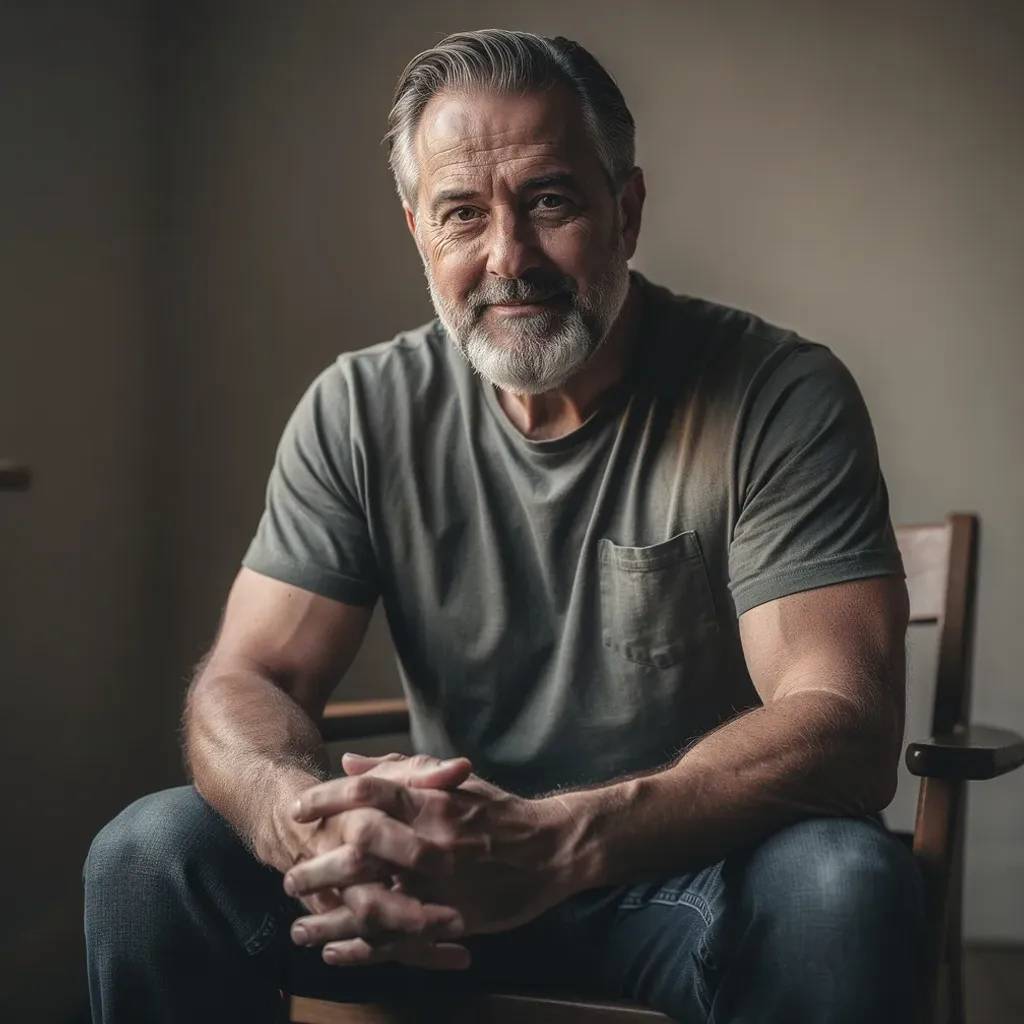
About David
Writes about purpose, meaning, and what happens when the life you built starts breaking you
Meet David
I had panic attacks in a parking lot at 40. Sitting in my truck outside my own business, hands shaking, chest locked, absolutely certain I was dying.
I wasn't dying. I was just finally hitting the wall I'd been sprinting toward for five years without realizing it.
I'm 50 now. The panic attacks stopped years ago. But I'm telling you about them because I think a lot of men are sitting in their own version of that parking lot, and most of them won't tell anyone.
The Setup
I grew up in a town where men worked. My dad was an electrician. He left the house at six, came home at six, ate dinner, watched the game, and did it again. Weekends he did side jobs or fixed things around the house. He wasn't unhappy. He was just occupied. There was always something that needed doing, and doing things was how he knew he was okay.
He showed love by showing up. Fixing the car when it broke down. Building the deck my mom wanted. Coaching my baseball team even though he'd rather have been doing anything else. He never said "I love you" much, but he never missed a game either. That was the deal. You show up, you work, you provide. That's what a man does.
I absorbed every bit of that. The work ethic. The reliability. The quiet assumption that your value comes from what you build and what you provide. I didn't question any of it for a very long time.
The Early Years
I married Karen when I was 25. Young, by most people's standards. But I knew. She was the person who made the noise in my head quiet down. Still is, most days.
I spent my twenties and early thirties working for other people. Project management, operations, the kind of work where you're the guy who keeps everything running. I was good at it, which is the problem with being good at things that aren't yours - you start wondering what would happen if you poured that energy into something that was.
We had Matt when I was 29. Sarah at 32. The house got smaller. The bills got bigger. Karen was teaching, and between the two of us we were fine, but I kept thinking: I can do more. I know how to build something. Why am I building it for someone else?
The Build
I started my own company at 35. Same year Jake was born - our third. Karen still jokes that I apparently decided one massive life change wasn't enough.
I took everything we'd saved and bet it on myself. The first two years were terrifying. Every month I wasn't sure we'd make payroll. I was estimating jobs, managing crews, handling clients, doing the books, answering every call - all of it. Karen picked up extra tutoring work to cover the gaps. She believed in me more than I deserved.
By year three, things started clicking. Good contracts. Good people. A reputation for doing what we said we'd do, which turns out to be rarer than you'd think. By year five, I had fifteen employees and more work than we could handle.
That's when things should have gotten easier. They didn't.
More work meant more people, which meant more problems. Employee issues, client disputes, cash flow crunches, insurance, regulations. Every decision ran through me because I'd built it that way. I was the center of a wheel with a hundred spokes, and every one of them needed something.
I poured everything into it. Every hour, every thought, every ounce of energy I had. I told myself this was what building something real looked like. This was providing for my family at a level my dad never could. This was success.
It was also slowly destroying everything that actually mattered.
The Breaking
By 40, I was working seventy-hour weeks. Sleeping five hours a night. My back hurt constantly. I drank more than I should have - not enough for anyone to comment on, just enough to turn the volume down at night.
Karen and I had stopped being partners and become logistics coordinators. Who's picking up the kids? Did you call the insurance company? I'll be late again tonight. Same conversation, different day. We were efficient. We were not connected.
The kids were growing up and I was missing it. Matt was eleven and I couldn't tell you who his friends were. Sarah was eight and I'd missed her school play because of a client meeting I convinced myself couldn't wait. Jake was five and had started telling people "Dad's always at work" like it was just a fact about the world, like saying the sky is blue.
The first panic attack came on a Tuesday morning. I was in the parking lot, about to walk into a meeting with a client who was threatening to pull our biggest contract. My chest seized. I couldn't get air. My vision narrowed to a pinhole. I gripped the steering wheel and genuinely believed I was having a heart attack.
It passed after fifteen minutes. I walked into the meeting. Smiled. Handled it. Drove home and didn't tell anyone.
The second one came a week later. Then another. Then they started coming two or three times a week, always in that parking lot, always before I had to walk through the door and be the guy who had everything under control.
I went to a doctor because I thought my heart was failing. It wasn't. My body was just refusing to carry what I'd been loading onto it for five years without rest.
Then Karen told me she was thinking about leaving.
Not in a fight. Not screaming. Just quietly, one night after the kids were in bed. She said she felt alone in her own marriage. She said she'd tried to reach me for years and I was never really there. She said she loved me but she couldn't keep living with someone who was present in the house but absent from the family.
I wanted to argue. I was doing all of this for her. For them. For us. Every hour, every sacrifice, every missed dinner - it was all for the family.
She looked at me and said: "The family needs you, David. Not your money. Not your business. You."
She was right. The whole thing - the marriage, the business, my health - was crumbling. And I was the one who'd built it that way.
The Stoics
I don't remember exactly how I found Marcus Aurelius. Probably a recommendation, maybe an algorithm. But I picked up Meditations - a private journal written by a Roman emperor who ruled during plague, betrayal, and war - and something clicked in a way nothing else had.
Here was a man with more responsibility than I could imagine, writing to himself about how to carry the weight without being crushed by it. Not motivational platitudes. Not "believe in yourself" nonsense. Practical, clear-eyed frameworks for handling things that are genuinely hard.
"You have power over your mind, not outside events. Realize this, and you will find strength."
I read Seneca next - a man who was one of the most powerful figures in Rome, lost everything, and wrote about what actually matters when the titles are gone. Then Epictetus, a former slave who taught that real freedom isn't about your circumstances, it's about your response to them.
These weren't soft philosophers contemplating abstractions. They faced worse than I ever had, and they built systems for it. Not theories. Systems. Practical, repeatable methods for handling adversity without being destroyed by it.
I started applying their ideas like a methodology. Focus on what you can control, release what you can't. That sounds simple. Actually doing it changed everything. When a client threatened to leave, I stopped spiraling and asked: what's in my control? My response, my effort, my preparation. The outcome? Not mine. Let it go.
Perception precedes action. When everything felt catastrophic, I forced myself to zoom out. In the scope of a life, in the scope of what actually matters, was this the disaster my emotions were telling me it was? Almost never.
The obstacle is the way. Whatever's blocking you contains exactly what you need to grow. I'd been running from difficulty my whole life. The Stoics taught me to see it as curriculum.
The Rebuilding
I didn't walk away from the business. I changed how I ran it.
I hired a general manager. Delegated the things I'd been hoarding. Accepted that some things would be done differently than I'd do them, and that was fine. The company didn't need me in every meeting, on every call, solving every problem. It needed me clear-headed and present for the decisions that actually mattered.
I started coming home at reasonable hours. Not every day - running a business doesn't work like that. But most days. Enough that Jake stopped telling people "Dad's always at work."
Karen and I started talking again. Real conversations. Not logistics about the house and the kids. Real conversations about what we wanted, who we'd become, whether we were building a life we actually valued. It was uncomfortable. We'd built up years of distance and quiet resentment, and closing that gap was harder than any business problem I'd ever faced.
There were nights when the honest thing to say was "I failed you" and the only honest response was "Yes, you did."
We rebuilt. Slowly, deliberately, the way you rebuild anything that matters. Not by pretending the damage didn't happen, but by building something stronger on top of the honest acknowledgment that it did.
I started reading philosophy every morning. Not because I'm some sort of intellectual - I'm not. Because it's maintenance. Without it, my mind drifts back to the old patterns. The overwork, the anxiety, the measuring my worth by what I produce instead of who I am. The daily practice keeps me calibrated.
Where I Am Now
I'm 50. Still married - twenty-five years now, and the last ten have been better than the first fifteen. That's not how most people's stories go, but it's ours. Karen says I'm a different man than the one she almost left. I think she's right.
Matt's in college. Sarah just finished high school. Jake's fifteen and reminds me more of myself than I'd like to admit - that same drive to prove himself through what he can build, what he can do. I'm trying to show him there's more to being a man than productivity. I'm not sure he believes me yet. I didn't believe it at his age either.
The business is still running. Fifteen years now. I'm less involved in the day-to-day than I used to be, which turned out to be the hardest lesson of all: the thing you built doesn't need you as much as you think it does. That's not a failure. That's the whole point.
I still have hard days. Still catch myself reaching for the old operating system - more hours, more control, more proof that I'm earning my place. The difference is I notice it now. I have frameworks to interrupt it. I have a practice that brings me back to center.
The Stoics had this concept: amor fati. Love of fate. Not just accepting what happens, but embracing it as necessary for who you're becoming. The breakdown at 40 was the worst thing that happened to me, and also the best thing. It broke me out of a system that was slowly destroying everything I actually cared about, and forced me to build something real in its place.
I write because I think a lot of men are where I was. Building without asking what they're building for. Providing without being present. Slowly cracking while telling everyone they're fine.
You don't have to wait until your body forces the question. You can start asking now: What do I actually want? Is this the life I'm building, or is this the life that's happening while I'm too busy to notice?
The obstacle isn't blocking your path. It is your path. Everything you need to grow is contained in whatever you're facing right now.
I didn't invent that idea. A Roman emperor wrote it in a tent during a military campaign two thousand years ago. I just learned to live it.
Maybe you can too.
If you want to get in touch, you can email me at [email protected]. I read everything, though I can't always respond.